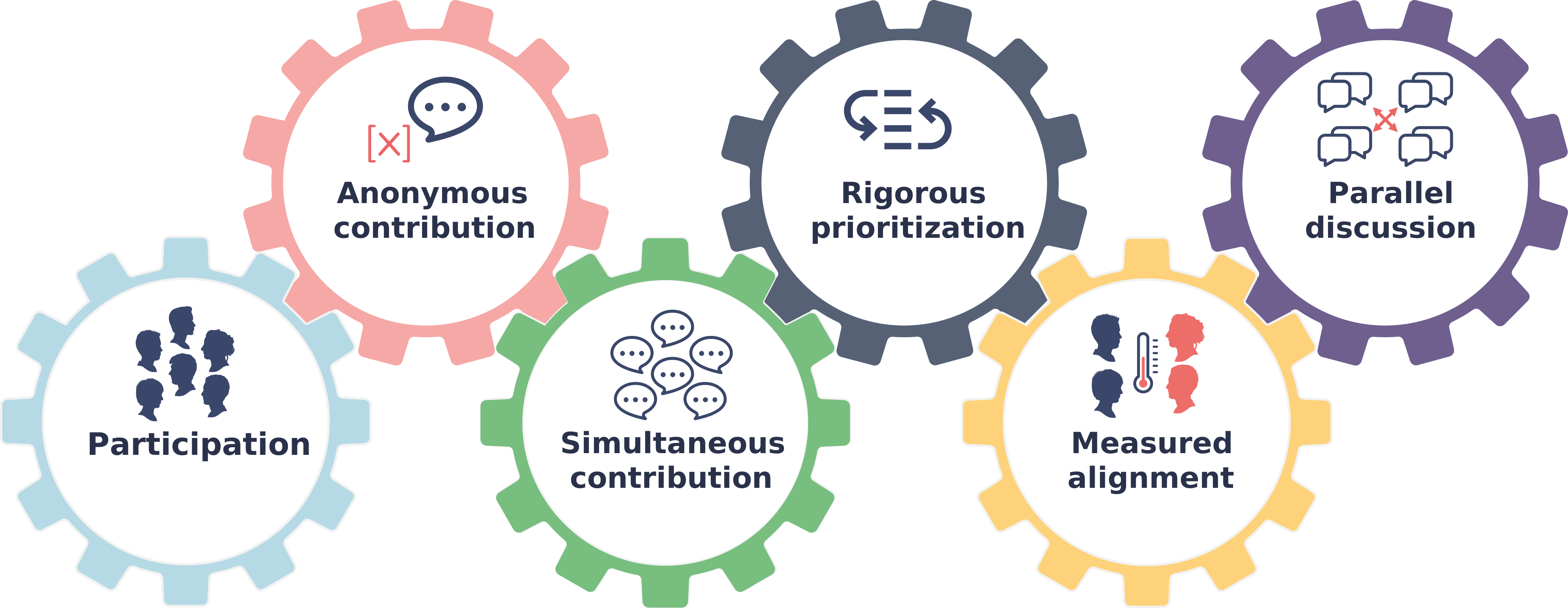
Anonymous contribution lets participants say what they actually think, keeps disagreement on substance, and lets them learn from stronger arguments without publicly backing down.
Candor makes the discussion relevant.
To get to the bottom of something non-obvious, participants must challenge assumptions, question evidence, expose weaknesses, qualify claims, and argue for different interpretations. Candor is essential if these exchanges are to be meaningful, or even relevant.
But every argument passes judgment on what came before. That makes candor socially costly—often prohibitively so.
The perceived cost of sharing what we actually think can be high even in groups and organizations proud of an open, supportive culture. There, the concern may be losing belonging rather than ridicule or retaliation. As the group grows, participants become increasingly careful about how much exposure a contribution creates.
And without anonymity, there is only one way to manage that exposure: manage what you say. Participants withhold, soften, dress up, qualify, or stay silent.
Well, at least we talked about it.
Anonymous contribution reduces the exposure by removing attribution, so participants do not have to resort to self-censorship.
That is critical to going deeper. If participants withhold the uncomfortable part, leave a weak argument unchallenged, or let a false assumption stand, the discussion does not merely stay shallow. It can positively mislead the workshop and anyone who builds on its output.
Keep disagreement on substance.
And the workshop can afford that candor. Criticism stays focused on the substance rather than on who challenged whom. Participants can disagree sharply without turning the exchange into a contest between identifiable people, roles, or hierarchies—or burdening future collaboration with the fallout.
Learning and progress.
In a candid discussion where contributions can only be judged on their substance, learning and progress stand a chance. The relevant information is shared. Participants do not visibly take a position with every argument they make. They can accept a stronger point regardless of whose point it is, revise their judgment, or let go of an earlier idea or argument without publicly backing down.
The discussion can progress because the people in it can move on—and freely share whatever new insight that produces.
Together, the two mechanics remove different constraints on meaningful discussion. Simultaneous contribution enables it mechanically: participants can contribute without waiting or being managed in a queue. Anonymous contribution enables it psychologically: participants can say what they actually think and exercise their judgment on substance alone.
Parallel discussion lets the group go deeper on more topics.