Advanced workshop mechanics
Parallel discussion

When a workshop has identified several priority or contested issues that deserve closer examination, another constraint appears. Legacy workshop mechanics let the group devote deeper discussion to just one topic at a time. Larger workshops can use breakouts to create additional conversations, but only by splitting the group and fragmenting context.

As a result, important issues remain underexamined. Whatever follows in the workshop—and any later decision that relies on its output—rests on incomplete understanding.

XLeap workshop software removes a constraint professionals previously had to accept. Several substantive discussions can progress at the same time, while participants contribute where their knowledge and perspective matter most.

Cogwheel with icon symbolizing advanced workshop mechanism Participation

Deeper understanding · Stronger foundations · More robust decisions

Request a demo

Incomplete understanding sets up unpleasant surprises

Identifying an important issue is not the same as understanding it. Different participants may hold different parts of the picture. They need to share what they know, add context, connect perspectives, and fill gaps before the group has a sound basis for what should follow.

If an important issue remains underexplored, subsequent work in the workshop starts from an incomplete picture. Responses may address symptoms rather than causes. Options may rest on assumptions nobody had the opportunity to challenge or substantiate.

That is bad enough in the workshop. Once plans or material decisions are built on that incomplete understanding, the consequences can become much more serious. Overlooked constraints or dependencies may surface later as unpleasant surprises. Even short of outright failure, they delay work, drive up costs, and can leave the people who relied on that understanding exposed.

One person speaks. One topic progresses.

In conventional spoken discussion, one person speaks at a time. Everyone else waits and listens. And the clock is ticking.

When participants cannot expect another chance to speak anytime soon—if at all—they have good reason to make their turn count. Several points get bundled into one slot, even when some do not fit exactly where the discussion is. And because there may be no later opportunity to clarify, each point gets more context, qualifications, caveats, and explanations. The contribution becomes longer and less direct.

That creates more work for the person running the workshop. Points have to be separated, redirected, deferred, or parked for later. Out of necessity, keeping the discussion on track means interrupting or containing the very engagement the workshop is trying to elicit. That is not poor facilitation. It is what the mechanic requires.

Longer contributions lengthen the queue. By the time someone further down the line gets their slot, the discussion will usually have progressed somewhat. Some prepared points are now out of place. But a speaking slot finally won is not easily surrendered. Earlier points are revived. Agreement is restated. More airtime goes into social signaling.

This is not a lack of discipline. An engaged participant with several things to contribute has no clean way to make each point where it belongs.

This is a vicious circle. Scarce airtime encourages longer, less focused contributions, lengthening the queue. Longer waits push more contributions out of context and require more facilitator intervention. Airtime gets scarcer still.

Unless participants get bored, give up, and disengage first.

And throughout all of this, only one topic has progressed. At the expense of everything else.

The obvious workaround is to split the group.

Breakouts split the workshop

Split twelve participants into two groups and two discussions can run at the same time. More people get a chance to speak. Two topics can progress instead of one.

And spoken discussion does work well in small groups. So why not keep dividing the workshop until every breakout is small enough for turn-taking to work naturally?

Yes. Breakouts create more conversations. But they sacrifice the shared reasoning needed for deeper understanding.

Breakouts split the perspectives.

Each discussion needs enough of the relevant knowledge and perspectives to understand why an issue has priority, why judgments diverge, or what sits behind a problem. The smaller the groups become, the more likely it is that someone holding an important part of the picture is sitting in another breakout.

Each participant can also take part in only one breakout discussion at a time. Their knowledge and perspective are therefore available to one topic at a time, even when they would matter elsewhere. The more the workshop divides people and topics, the more likely it is that expertise and insights are missing elsewhere.

Walking around does not solve the problem. First, participants cannot know when and where the need for their perspective will arise. Then, a participant arriving in another breakout has missed the reasoning that brought that breakout to where it is. The group may need to recap, the newly arrived participant may repeat points already made, and the participant may be missed when their original breakout needs them again.

Breakouts fragment facilitation.

The person running the workshop can follow only one breakout at a time. In the others, they cannot see when a discussion stalls, drifts, gets bogged down, or needs help moving forward.

And someone usually fills the gap. It may be the most senior person in the group. It may be the most confident or simply the most vocal. Before long, the breakout has its own informal facilitator—and the hierarchy or dominance patterns the workshop was meant to manage creep back in.

Reporting back loses the reasoning.

Whatever the groups develop separately then has to be brought back together. Each breakout needs to prepare what it will report. Those reports happen one after another. Two breakouts do not simply double usable discussion time. Add more groups and the reintegration burden grows with them.

Conclusions can be summarized. Much of the reasoning, qualification, challenge, and context that produced them stays behind. So does much of the deeper understanding the discussion was meant to create in the first place.

That is the Catch-22. The richer the breakout discussion, the more there is to lose when it is compressed into a report-back. If the plenary has to reopen the reasoning to recover that understanding, still more of the apparent time gain disappears.

These issues compound. Breakouts cannot simply be multiplied until spoken turn-taking works comfortably in every group. Smaller groups improve the conversation mechanics, but progressively weaken shared access to people, perspectives, and context—and consume more workshop time trying to put the pieces back together.

Discuss in parallel without splitting the group

In XLeap’s Discussion workspace, several topics can be discussed without splitting the group.

The Host sets up multiple priority or contested topics. Instead of being assigned to one discussion, participants decide which topics they join and when.

Participants concentrate on the topics that interest them most or where they have something specific to contribute, and switch between them frequently, keeping an eye on the rest. Item counters show how much has been contributed to each topic and what remains unread. That makes activity transparent across topics and helps participants scan.

When participants spot that a discussion they are scanning has moved into territory which piques their interest or where their knowledge or perspective matters, they can join it.

When they do, they are not entering cold. They have already scanned how it developed up to that point. They can look up specific prior arguments in the thread and respond to earlier points without disrupting anybody else’s flow.

Simultaneous contribution creates the time

Twenty minutes of discussion with just 12 participants consume 240 minutes of participant time. In an oral, turn-taking conversation, one person contributes while the other 11 are expected to listen.

That mechanic is not just slow. It asks the group to give every contribution its undivided attention, which is unrealistic. Attention drifts. Participants disengage. Those who stay engaged try to make their speaking slots count by bundling multiple points, because they have no clean way to make each point where it belongs. This is wasteful. And the list goes on.

Simultaneous contribution changes all of that—including the arithmetic. Participants can read, think, contribute, and respond without waiting or being managed in a queue. The same 20-minute slot yields four participant-hours of active discussion work.

Those four participant-hours are not four hours of typing. Meaningful discussion still takes time. Participants need to read, think, let compelling arguments sink in, connect them with what they know, and respond.

Making each discussion faster does not solve the problem if several substantive discussions still have to run one after another. Make the slots too short, and quality suffers.

Parallel discussion is the answer. Simultaneous contribution creates the capacity to make it work.

Anonymous contribution enables candor and progress

Anonymous contribution lets participants say what they actually think, keeps disagreement on substance, and lets them learn from stronger arguments without publicly backing down.

Candor makes the discussion relevant.

To get to the bottom of something non-obvious, participants must challenge assumptions, question evidence, expose weaknesses, qualify claims, and argue for different interpretations. Candor is essential if these exchanges are to be meaningful, or even relevant.

But every argument passes judgment on what came before. That makes candor socially costly—often prohibitively so.

The perceived cost of sharing what we actually think can be high even in groups and organizations proud of an open, supportive culture. There, the concern may be losing belonging rather than ridicule or retaliation. As the group grows, participants become increasingly careful about how much exposure a contribution creates.

And without anonymity, there is only one way to manage that exposure: manage what you say. Participants withhold, soften, dress up, qualify, or stay silent.

Well, at least we talked about it.

Anonymous contribution reduces the exposure by removing attribution, so participants do not have to resort to self-censorship.

That is critical to going deeper. If participants withhold the uncomfortable part, leave a weak argument unchallenged, or let a false assumption stand, the discussion does not merely stay shallow. It can positively mislead the workshop and anyone who builds on its output.

Keep disagreement on substance.

And the workshop can afford that candor. Criticism stays focused on the substance rather than on who challenged whom. Participants can disagree sharply without turning the exchange into a contest between identifiable people, roles, or hierarchies—or burdening future collaboration with the fallout.

Learning and progress.

In a candid discussion where contributions can only be judged on their substance, learning and progress stand a chance. The relevant information is shared. Participants do not visibly take a position with every argument they make. They can accept a stronger point regardless of whose point it is, revise their judgment, or let go of an earlier idea or argument without publicly backing down.

The discussion can progress because the people in it can move on—and freely share whatever new insight that produces.

Together, the two mechanics remove different constraints on meaningful discussion. Simultaneous contribution enables it mechanically: participants can contribute without waiting or being managed in a queue. Anonymous contribution enables it psychologically: participants can say what they actually think and exercise their judgment on substance alone.

Parallel discussion lets the group go deeper on more topics.

Parallel discussion lets the group go deeper on more

Rigorous prioritization shows which issues genuinely deserve attention. Measured alignment reveals where judgments differ significantly. Together, they expose the gap between what the workshop requires and what legacy mechanics can provide.

Accepting those limits is now a choice.

Simultaneous contribution creates the time. Anonymous contribution enables candor and lets participants exercise their judgment on substance alone. XLeap’s Discussion workspace combines both advanced mechanics so the group can sustain substantive discussion across multiple topics at once.

The arithmetic makes the new possibilities tangible. In our example, 12 participants in a 20-minute slot have 240 participant-minutes available. Spread across 12 topics, that is about 20 participant-minutes per topic, less the time participants spend scanning other discussions. Across six topics, it is about 40.

The same 20 minutes now support a depth of discussion that oral turn-taking cannot. Participants contribute without waiting or stuffing several points into a speaking slot. They direct their attention where their interest or knowledge takes them. They can be candid without exposing themselves and judge arguments on substance. Attention is not held hostage by whoever happens to be speaking. Time is not lost to queues and social signaling. The group can learn and progress.

Interlocking mechanisms

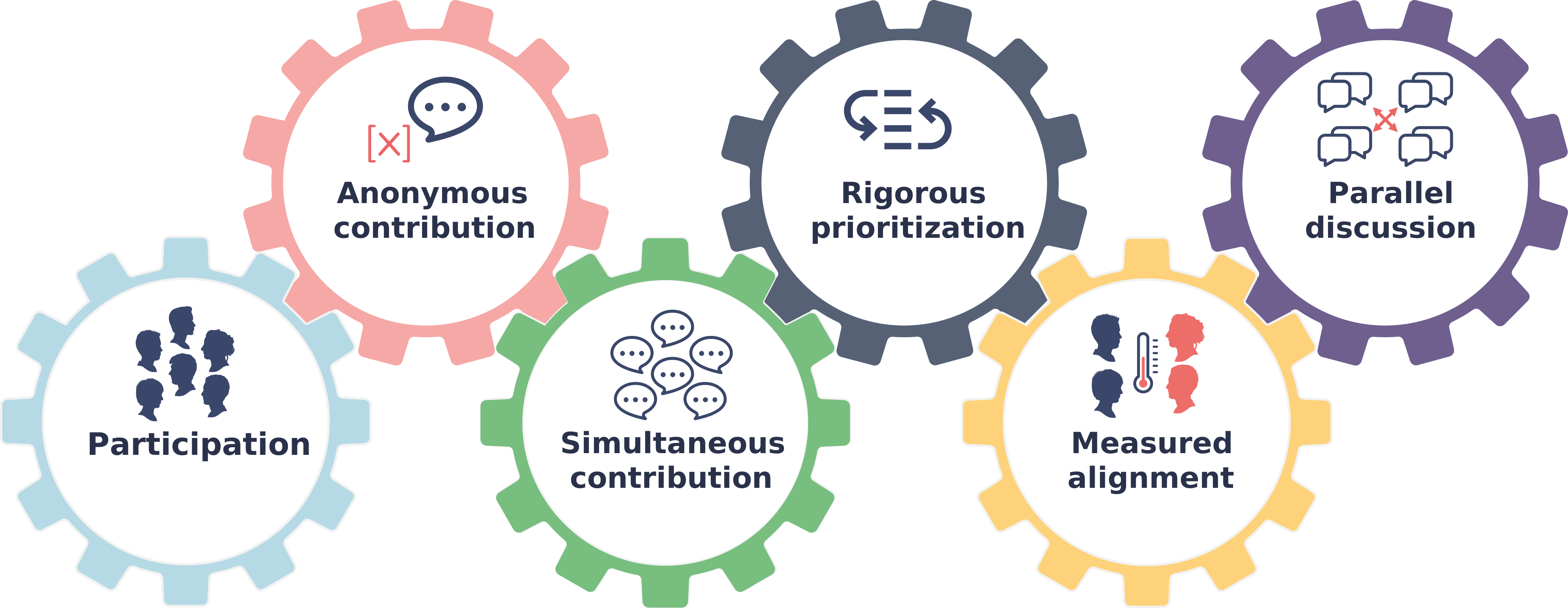
Each advanced workshop mechanism removes a different constraint on consequential group work.

Participation brings the relevant people into the workshop. Anonymous contribution lets them share what they actually think without exposing themselves. Simultaneous contribution turns far more of their time into productive contribution. Rigorous prioritization shows which issues genuinely deserve attention. Measured alignment reveals where judgments differ significantly.

Parallel discussion lets the group take the next step: examine several priority or contested issues in the required depth before the workshop progresses to its next phase or its output informs material decisions.

Together, the six mechanisms put more of the group’s knowledge and judgment to work—for stronger solutions and more robust decisions

Six interlocking cogwheels representing XLeap’s workshop mechanisms.

Participation is one of six interlocking mechanisms that let professionals run productive workshops across settings.

EXPLORE THE OTHER MECHANISMS

Participation · Anonymous contribution · Simultaneous contribution · Rigorous prioritization · Measured alignment

Go deeper on more of what matters

XLeap lets groups examine significantly more priority or contested issues in the depth they require. Participants contribute without waiting, can be candid without exposing themselves, and direct their attention where their knowledge and judgment matter.

What follows in the workshop—and the solutions and decisions built on its output—can rest on deeper understanding and stronger foundations.

Deeper understanding · Stronger foundations · More robust decisions

Request a demo

EXPLORE FURTHER

Use cases · Workspaces