When contributing means exposing yourself, people instinctively manage that exposure by managing what they say. Good facilitation will encourage honesty and open-mindedness. It will propose new, more enlightened rules. But it cannot change ingrained behavior or compensate for withheld information or source-biased judgment.
XLeap changes what is possible. Professionals can grant anonymity. Participants can share honestly what they know and think. Their contributions stand on substance. The group can challenge, build on, and revise ideas without making every contribution a personal position.
This page explains how Anonymous contribution removes what may be the most damaging source of workshop failure.
Candor · Substance · Progress
Information that is withheld cannot be challenged, combined with other input, prioritized, or assessed. For the purpose of the workshop, it simply does not exist. What is shared but sugarcoated enters already distorted. Then the status, role, affiliation, or identity of the person who shared it can distort judgment again: important issues are discounted. Secondary issues rise to the top.
The concrete consequence depends on the task. But no workshop can afford compromised inputs and expect dependable outputs.


Good culture does not remove the trade-off.
This is not a question of good or bad organizational culture. In an organization that feels like a family, relationships and belonging matter all the more. Nor does the problem disappear when the stakes are low. The pressure may be weaker, but so is the reason to take even a small social risk. Why risk a relationship, reputation, or belonging when little depends on speaking up?
Broader groups make the social terrain harder to read.
The broader the group, the harder it becomes to keep track of who has relationships with whom, whose interests align, what may travel beyond the room, and what all that might mean. When the social terrain can no longer be read with confidence, uncertainty itself creates caution. People protect themselves not because they see specific risks, but because they cannot see where the risks are.
Facilitation cannot control the consequences of exposure. Participants know that.
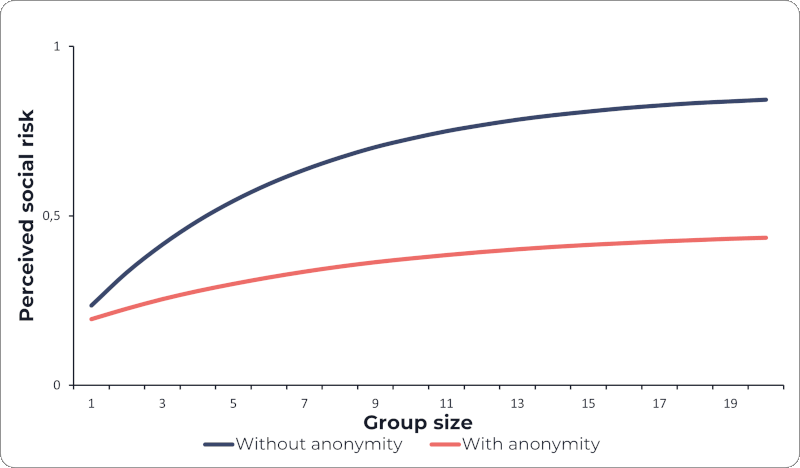
Anonymity reduces perceived social risk as groups grow.
(Illustrative curve, not to scale)

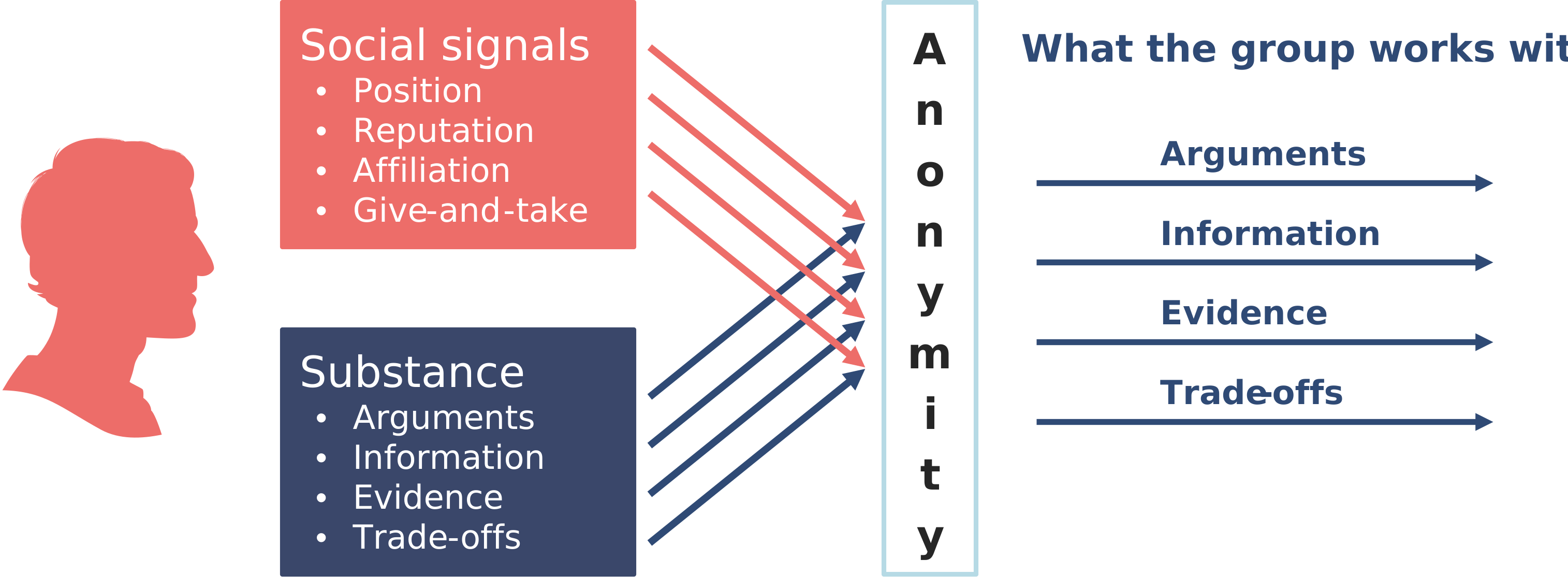
Anonymity strips away source signals so claims can be tested on substance.
XLeap strips away those barriers to scrutiny. With the source stripped away, a contribution has to stand on substance. Anonymous contribution lets participants question claims, challenge assumptions, ask for evidence, and expose weak reasoning with candor. Simultaneous contribution lets them do so when the question is relevant.
Bring it out. Then test it.
XLeap Rating asks for judgment in a structured form. Participants assess importance, effectiveness, feasibility, risk, priority, or whatever else the task requires. When those ratings reveal the person making them, the judgment becomes personal. Rating a senior colleague’s proposal poorly, rejecting the position of your own department, or recording a view that differs sharply from others exposes the participant behind the judgment.
Anonymous Rating removes that exposure. Participants can honestly record the judgment they actually hold rather than the judgment they are prepared to be identified with.
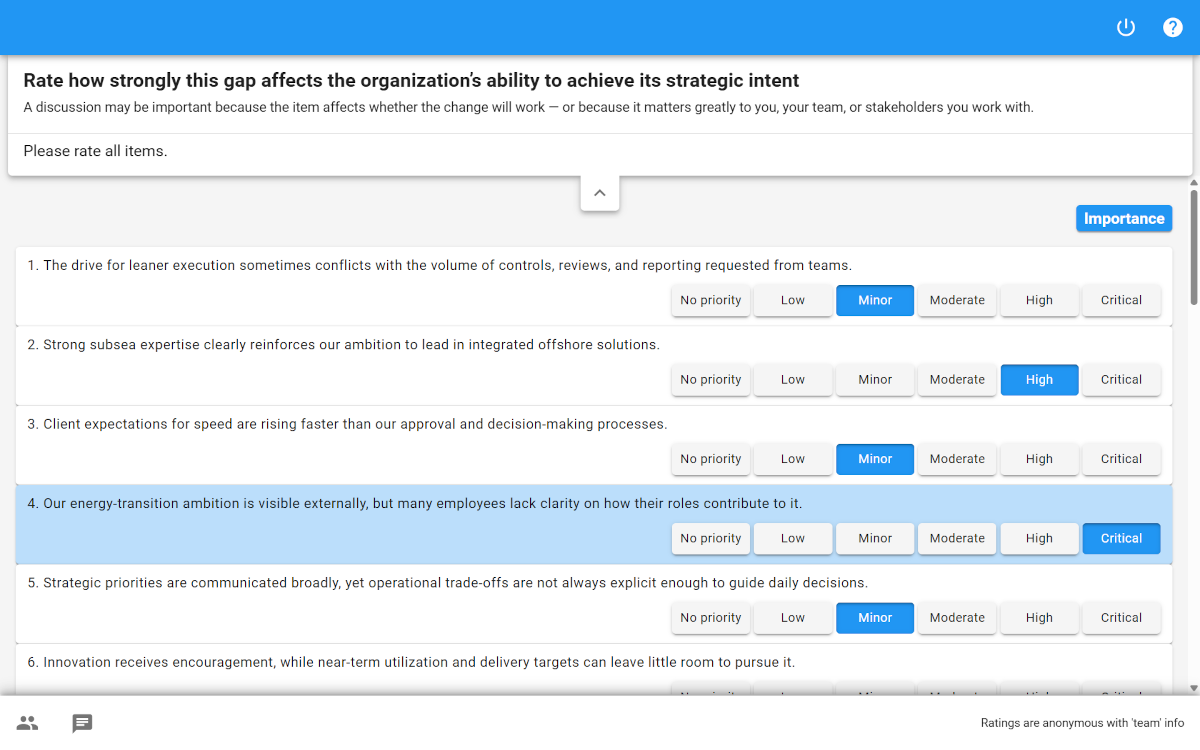
Anonymous Rating lets participants record their actual judgment.
That matters because Rigorous prioritization makes structured Rating practical whenever the work requires it. The more consequential the judgments a workshop asks participants to record, the more important it becomes that those judgments are honest.
Measured alignment depends on the same integrity. If participants adjust ratings to make them socially acceptable, any measure of alignment is skewed by those adjustments. Honest ratings show where judgments genuinely align and where they differ.

Group context without personal attribution.
XLeap supports full anonymity, anonymous contribution with a participant-group label, and named contribution. Hosts can define participant groups such as departments, functions, or teams. Participants then select the group that describes them while remaining personally anonymous. This is particularly valuable in Rating, where priorities and alignment can be analyzed across participant groups without exposing individual judgments.
Use names only when the task requires them.
While named contribution remains available, Hosts rarely use it once anonymity is available. Participants value the freedom anonymity gives them, and most workshop tasks need the contribution rather than the name behind it.
Even where individual follow-up is useful, personal attribution need not be enforced by a setting. Most Hosts simply ask participants to add their name or contact details to a contribution if they want someone to follow up with them.
The rule is straightforward: expose personal identity only when the task requires it.
Bring out the information the work needs. Keep personal exposure out of it.
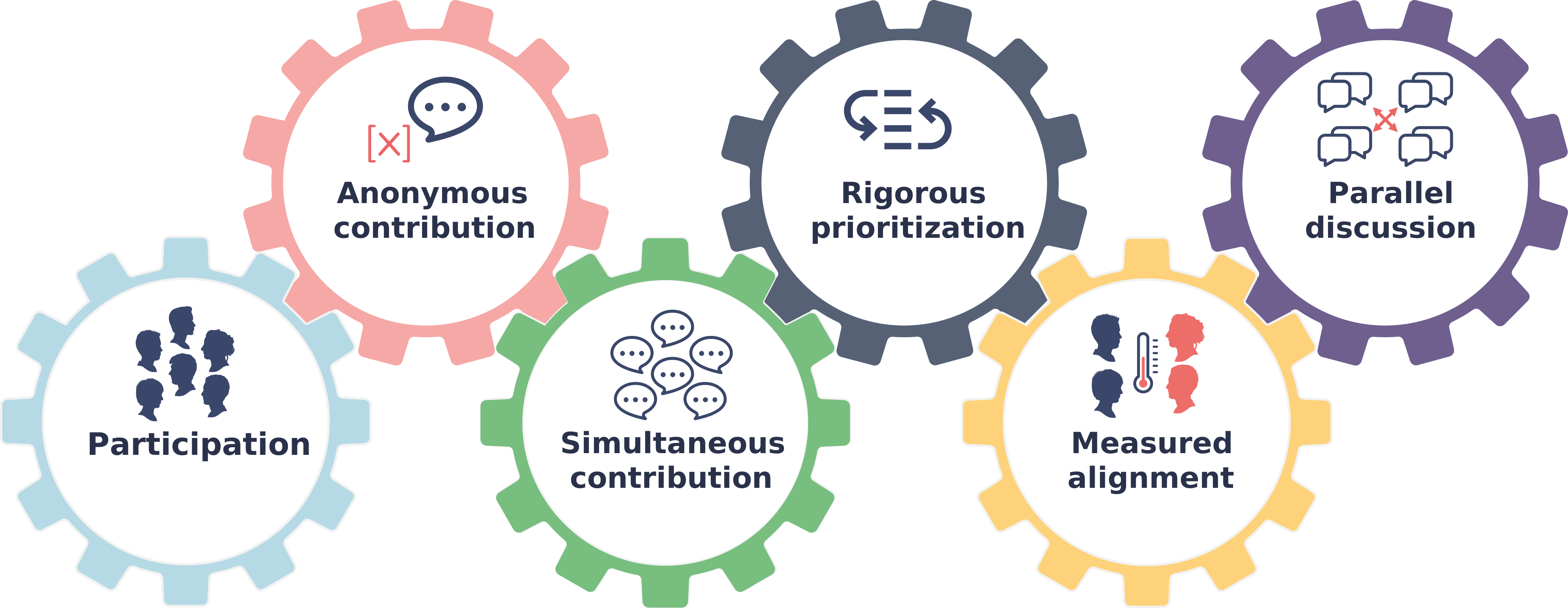
Together, the mechanisms produce stronger solutions and more robust decisions.
EXPLORE THE OTHER MECHANISMS
Participation · Simultaneous contribution · Rigorous prioritization · Measured alignment · Parallel discussion
EXPLORE FURTHER