Health, Safety & Environment workshops
Fuller disclosure, clearer priorities, more effective controls

HSE leaders use workshops to bring together what workers, contractors, supervisors, operations, and HSE specialists know—and judge what matters most.

But conventional workshop mechanics let them down. The larger the group, the less productive the workshop. Relevant perspectives must therefore often be left out. And even with a limited group, those present often struggle to get a word in. HSE-critical observations are withheld or sugar-coated, and disclosed input can be discounted because of who raised it. Finally, weak prioritization methods obscure what should take priority. Priority issues get shortchanged.

With XLeap workshop software, HSE leaders can involve everyone whose perspective matters, grant anonymity where candor is essential, and let participants contribute whenever they have something to add.
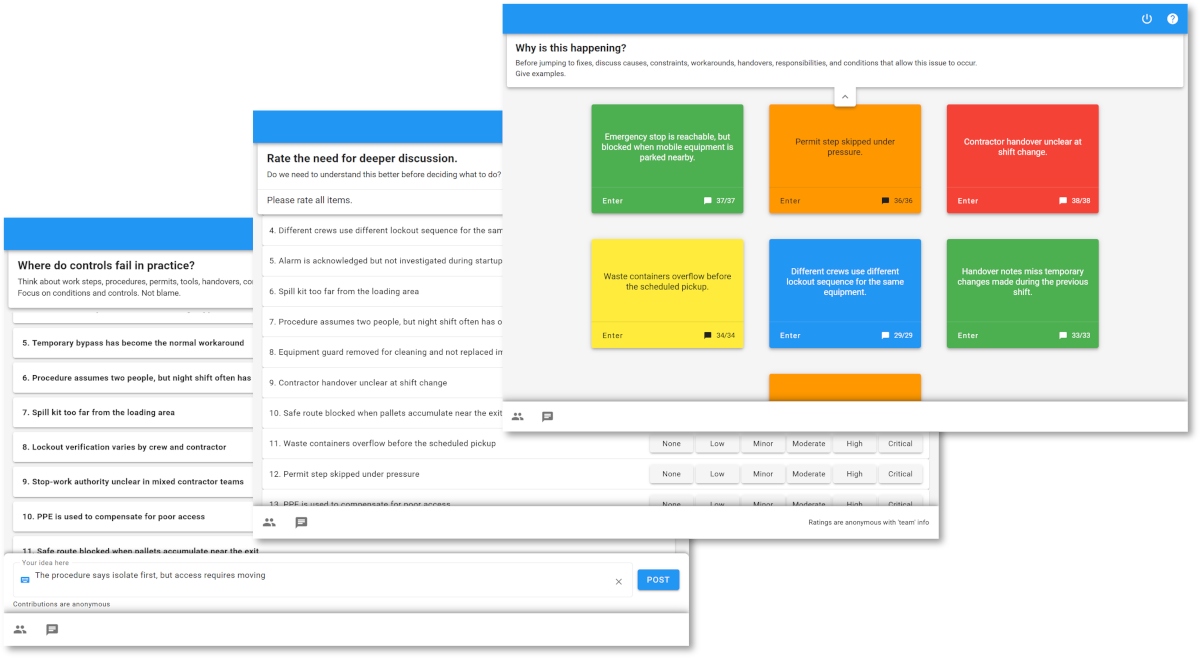
Composite screenshot of XLeap Brainstorm, Rating, and Discussion Workspaces used to collect control-gap observations, rate the need for deeper discussion, and discuss prioritized HSE issues.

From HSE observations to deeper discussion.

Whatever the setting—in-room, virtually across locations, or hybrid—participants can disclose HSE-critical observations honestly, rate what deserves attention, and then work through prioritized issues, causes, constraints, and controls. That gives HSE leaders stronger evidence and clearer priorities. They can target corrective actions more effectively and strengthen controls.

Fuller disclosure · Clearer priorities · Stronger controls
Request a demo

Make HSE-critical observations safe to disclose

In HSE workshops limited to conventional mechanics, the observations that matter most can be too hard to disclose.

Saying that a control is present but ineffective, a procedure is worked around in practice, a permit step is skipped under time pressure, a contractor interface is unclear, or a near miss has become routine can feel like admitting fault, criticizing a supervisor, exposing a colleague, or creating trouble for a contractor.

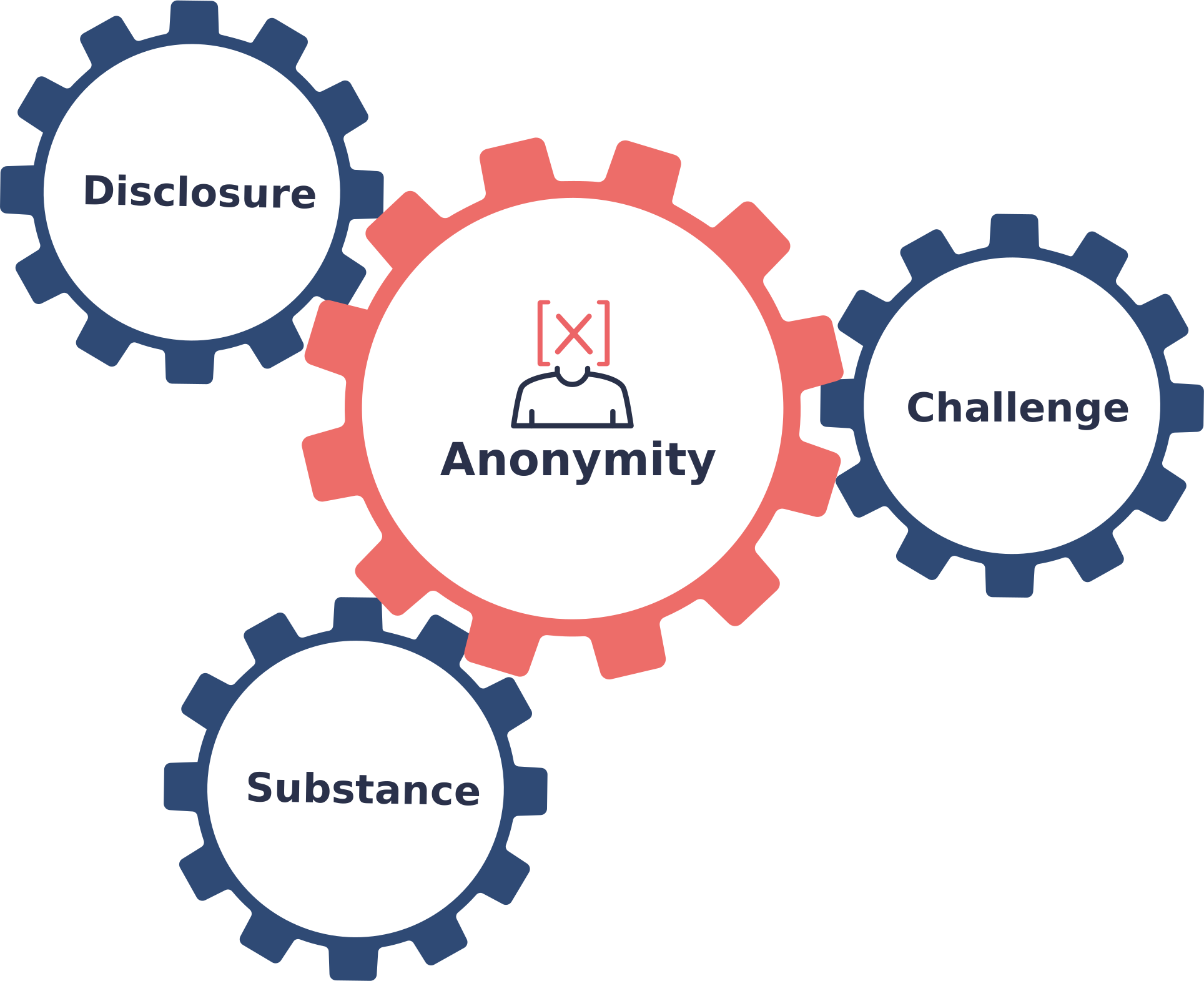
Cogwheel diagram showing anonymity driving disclosure, substance-based assessment, and constructive challenge in HSE workshops.

Anonymity makes the hard parts discussable.

So valid HSE input gets filtered before the group can assess it. It is withheld, softened, or stripped of the detail that would make it useful.

XLeap lets HSE leaders grant anonymity where disclosure matters. Participants can disclose hazards, deviations, weak controls, near misses, unsafe conditions, and environmental concerns without having to put themselves on the line.

That changes the workshop dynamic. HSE-critical input can be assessed on substance—not on who raised it, who may be implicated, or how uncomfortable it is to hear.

LEARN MORE ABOUT THE POWER OF ANONYMITY

Bring in every relevant perspective

Anonymity makes HSE-critical observations safe to disclose. But disclosure must also be possible in practice. Without airtime, even candid participants cannot contribute what they know.

HSE workshops often depend on people who do not contribute on equal terms in a conventional meeting: workers, contractors, supervisors, operations, maintenance, environmental specialists, and HSE.

The problem is not only who is invited and who turns up. It is whether the workshop mechanics let them contribute.

When participants take turns speaking, one person’s contribution blocks everyone else’s. Airtime is scarce—and it becomes even scarcer when people dominate. Some voices get a disproportionate share of airtime. Others do not get a word in and cannot add what they know. This often applies to frontline or contractor input: it is not raised or cut short and, consequently, cannot be considered.

Breakouts create more airtime, but each breakout still depends on taking turns. While one person speaks, everyone else is silent. And because each breakout hears only its own discussion, context is split across breakout groups.
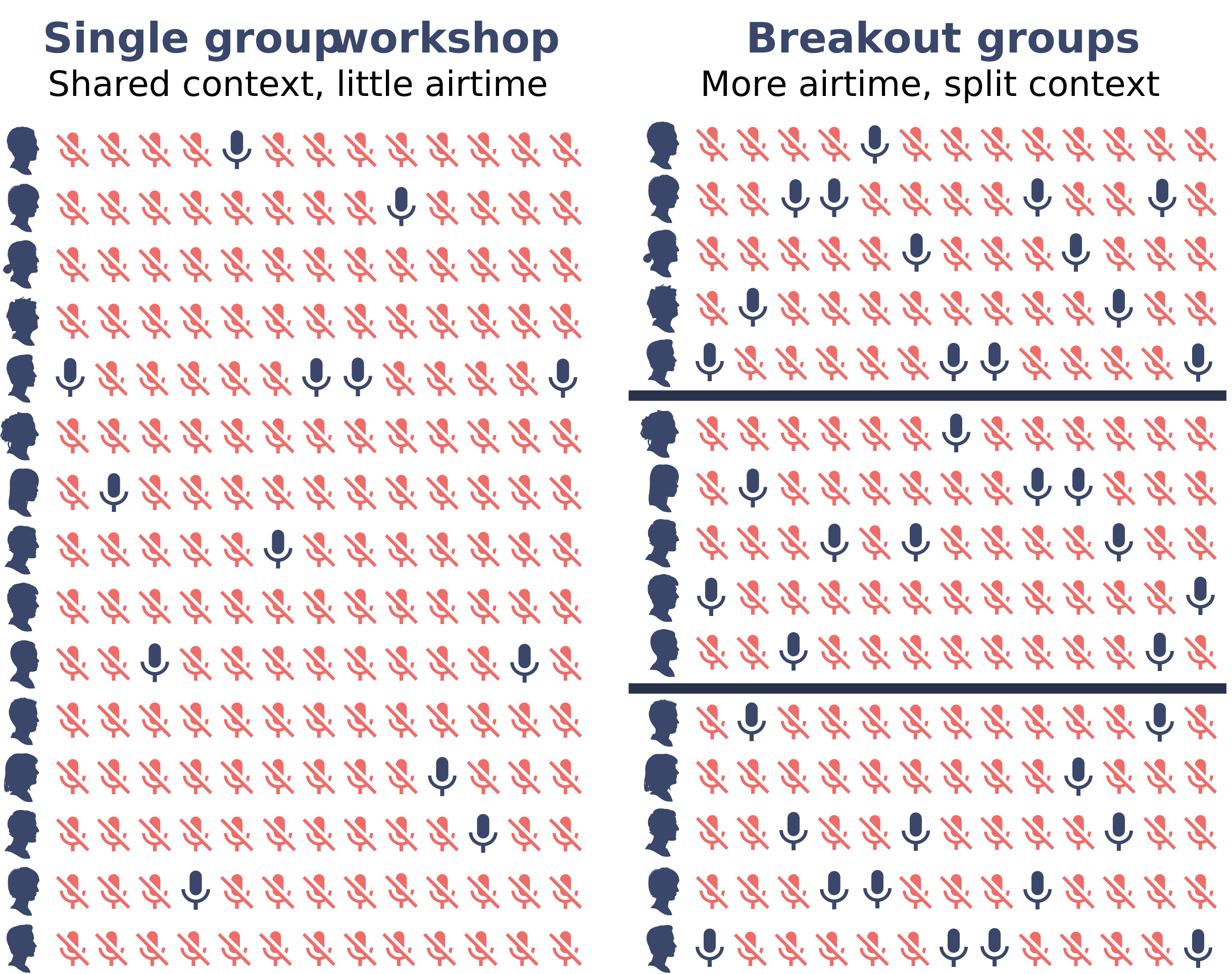
Diagram comparing plenary and breakout formats in an HSE workshop: plenary keeps shared context but limits airtime; breakouts create more airtime but split context.

The traditional workaround: trade shared context for airtime.
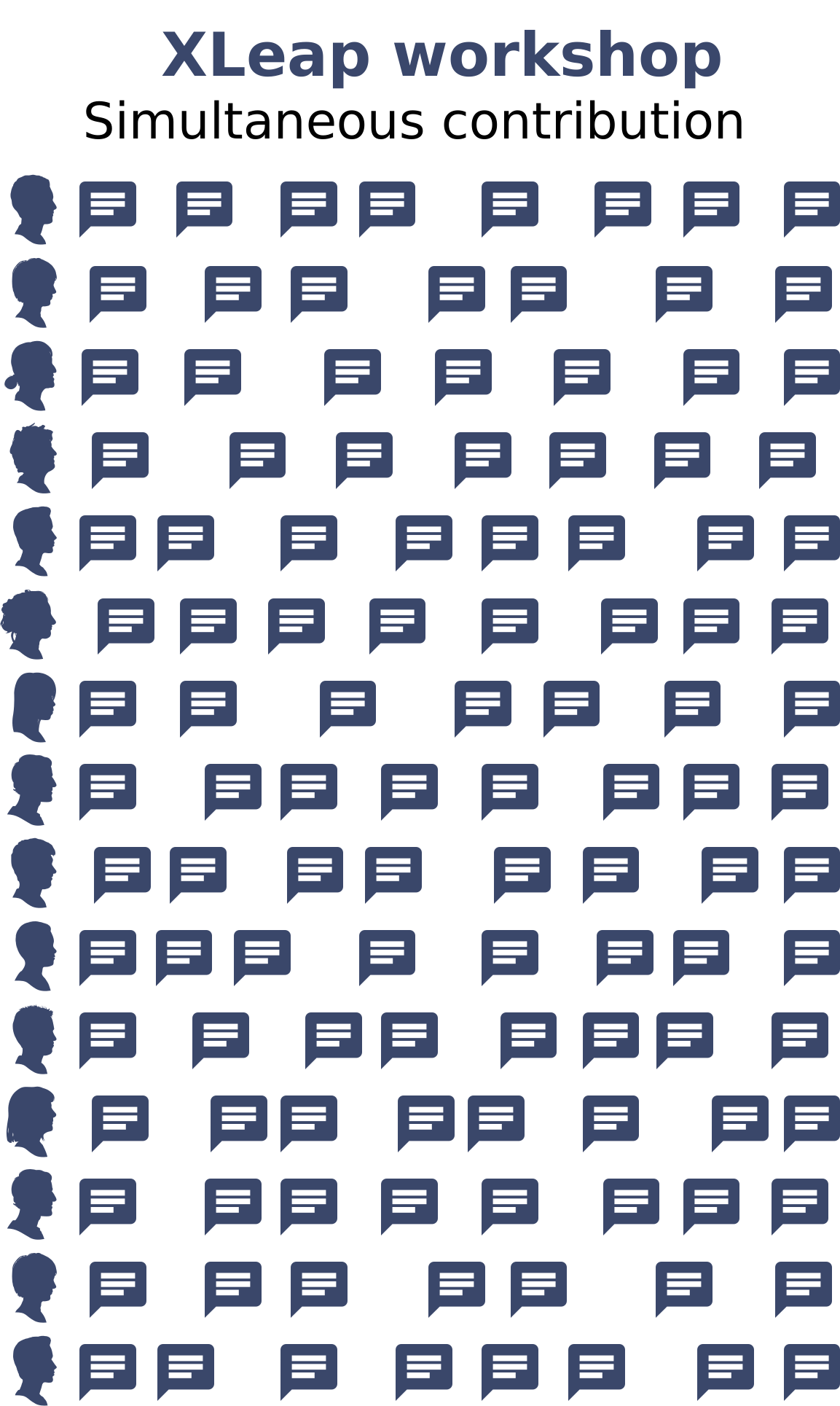
Diagram showing an XLeap HSE workshop where participants contribute in parallel within the same shared workshop context.

More contribution, shared context.

XLeap changes the mechanics. Its workspaces are designed for different workshop tasks—such as surfacing observations, reviewing work steps, assessing control gaps, rating corrective actions, or discussing options—and the Host can tailor prompts and settings to the session.

Participants add input in parallel instead of waiting for airtime. They respond to the same focused task, so more relevant information enters the workshop without letting the session drift.

Where useful, the Host can create participant group labels—for example function, site, shift, role, or contractor category. XLeap can then label contributions or ratings with those group names, so differences between groups become visible while personal anonymity remains protected.

The result is more HSE-relevant information from the people whose perspective matters—not just from those who get a word in.
Prioritize what deserves discussion

Once HSE-critical observations have been disclosed and relevant perspectives have contributed, the workshop has to decide where to drill down.

That step is often weaker than it should be. With conventional workshop mechanics, the shortlist for discussion is easily shaped by airtime, seniority, recent incidents, or familiar concerns. Sticky dots are tangible and simple, but blunt: they do not show where groups differ, and duplicate versions of the same issue can split the vote, making its HSE significance look smaller than it is.

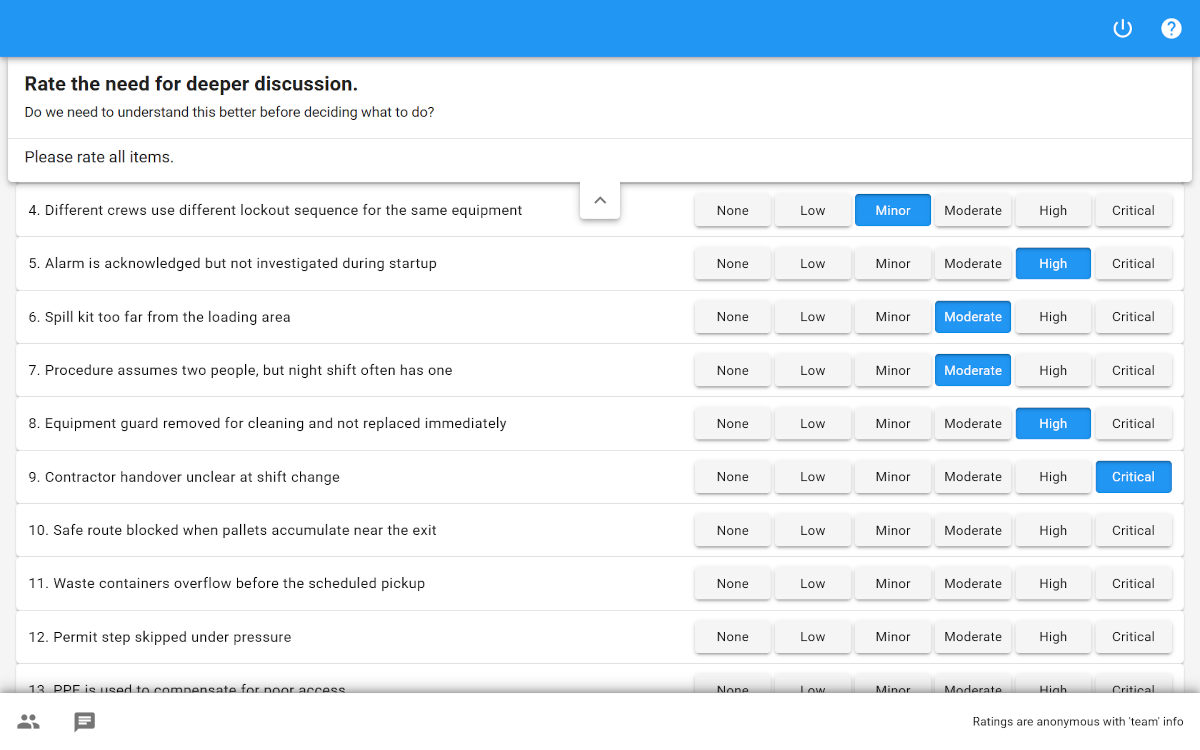
XLeap lets HSE leaders make the triage explicit. Participants can rate observations to identify what deserves closer discussion, using the criterion that fits the session: HSE significance, need for closer review, potential severity, exposure, number of people affected, control effectiveness, compliance urgency, environmental consequence, or action priority.

Results are available immediately in tables and charts. HSE leaders can see the whole-group result—and, where group labels are used, how ratings differ by function, site, shift, role, or contractor category.

That matters because the overall score may hide a critical signal. An issue can look mediocre across the whole group because many participants do not see the problem directly. But the group closest to the observation—for example frontline workers, maintenance, or contractors—may rate it as highly significant.

XLeap lets HSE leaders use both views: what the group as a whole prioritizes, and where the people closest to the issue see something different. Limited workshop time can then be used to understand the selected issues more deeply and shape stronger corrective actions.

Then, after discussion has clarified what is failing and why, XLeap supports more detailed multi-criteria rating. HSE leaders can quantify control gaps or proposed corrective actions on the dimensions their process requires—for example severity, exposure, control effectiveness, feasibility, risk reduction potential, implementation urgency, or confidence in the proposed action.

XLeap gives HSE leaders the tools to structure prioritization on their terms: start with explicit triage, use group differences to decide where deeper discussion is needed, and then quantify control gaps or corrective actions against the criteria their HSE process requires.

LEARN MORE ABOUT RATING

XLeap Rating sheet: fast triage for deeper discussion.
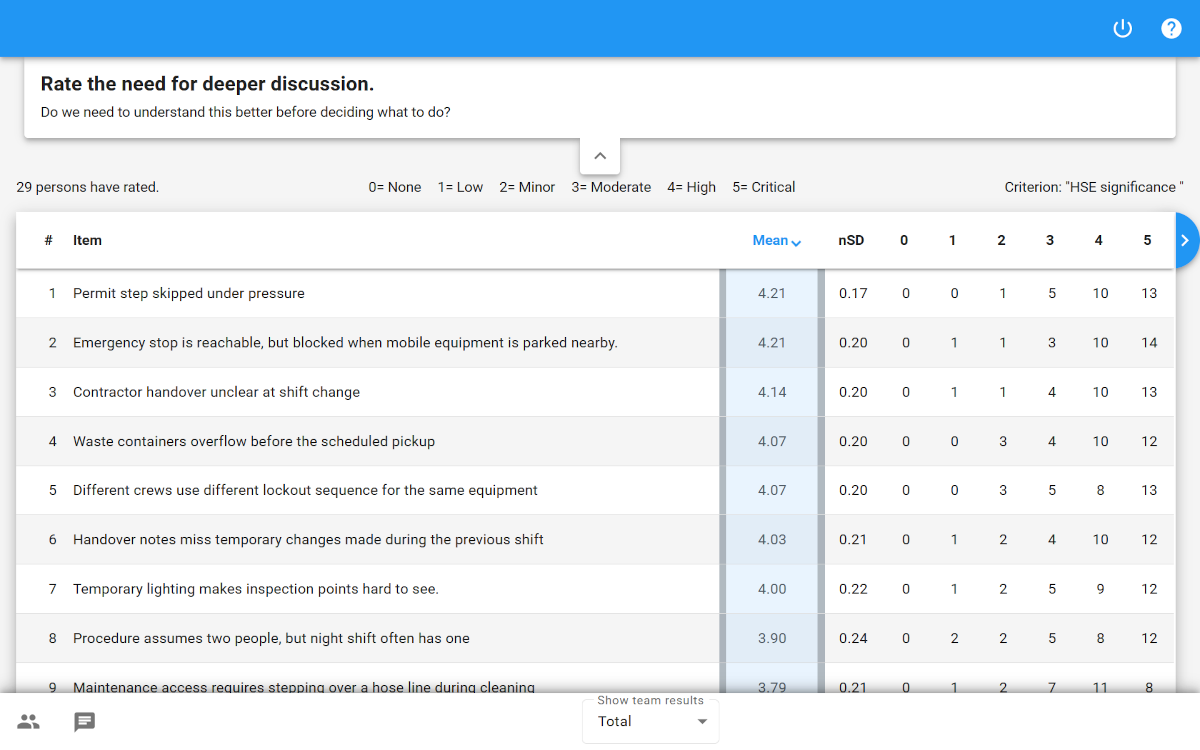
Instant results show what deserves discussion.
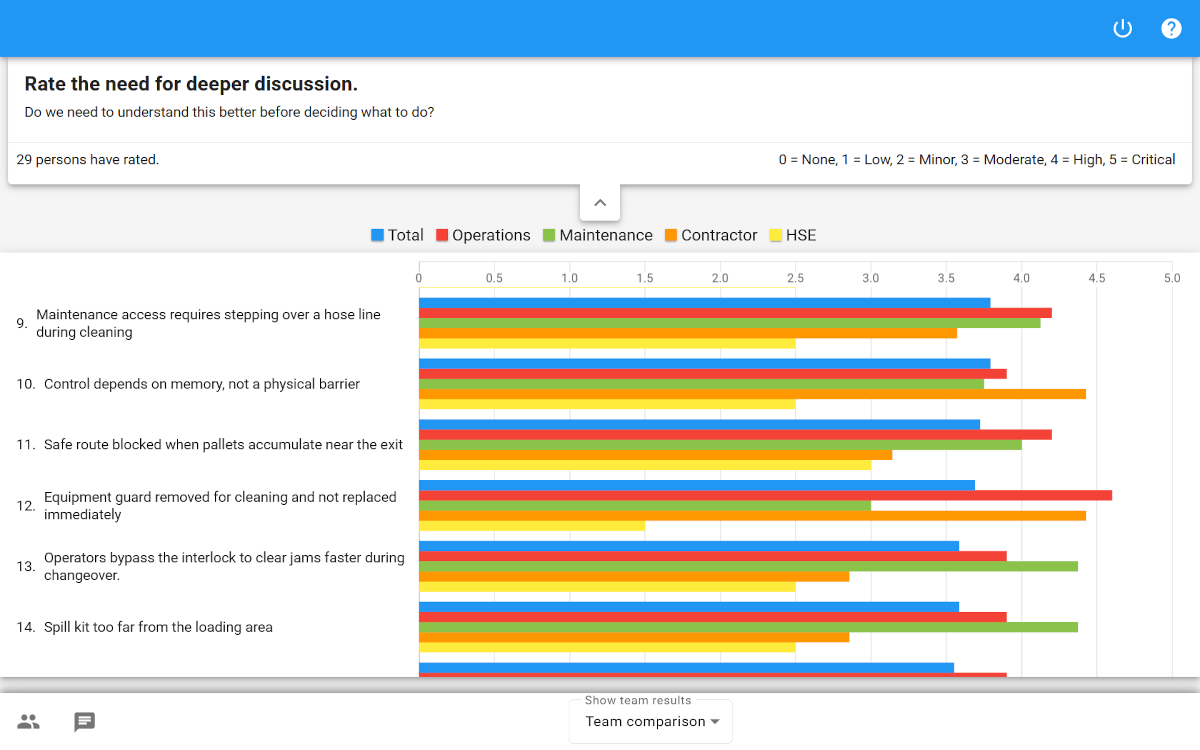
Results chart showing where the need for deeper discussion differs by participant group.

Go deeper on more of what matters

Bringing out HSE-critical observations and prioritizing them accurately is essential. But it only shows where work needs to be done.

At that point, the workshop has identified the right issues—but it has not yet produced the understanding of causes, constraints, and failure mechanisms required to define corrective actions that will hold up in practice.

Conventional workshop mechanics make that work harder, slower, and more costly than necessary. In plenary, the group can examine only one issue at a time, and every contribution blocks everyone else from contributing. Breakouts create some parallel discussion time, but they split context, add coordination overhead, and still allow only a handful of issues to be worked through before time runs out.

The result is familiar: too little time is spent on why a control fails, where the procedure breaks down, which constraint matters, or what would make it easier to work safely. Under time pressure, the group is tempted to move too quickly from “this is important” to surface-level fixes: remind people, retrain people, communicate better, restate the rule. Social dynamics can also re-enter the discussion: issues are softened, uncomfortable causes remain hidden, and relevant information or proposed corrective actions can be accepted or rejected too quickly because of who raised them.

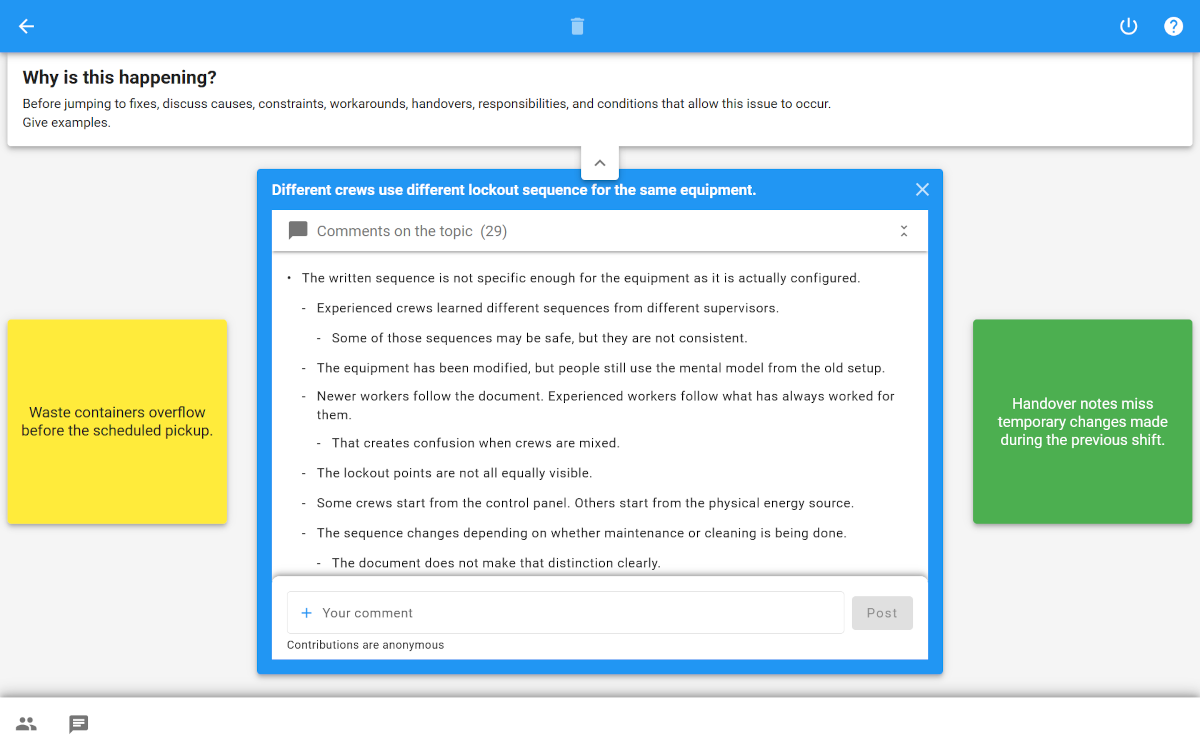
XLeap changes the discussion mechanics. In the Discussion workspace, an XLeap Host can open several issues prioritized for deeper discussion—or proposed corrective actions—in parallel. Participants add causes, examples, objections, constraints, and improvement ideas directly to the issue under discussion, instead of waiting for airtime in a single plenary conversation or losing context in separate breakouts.

In HSE work, candor is not optional. The discussion has to reach the uncomfortable parts: why a control fails, where a procedure is impractical, which constraint is being worked around, and which corrective action would actually reduce exposure—even if it is inconvenient for a function, site, supplier, or contractor relationship.

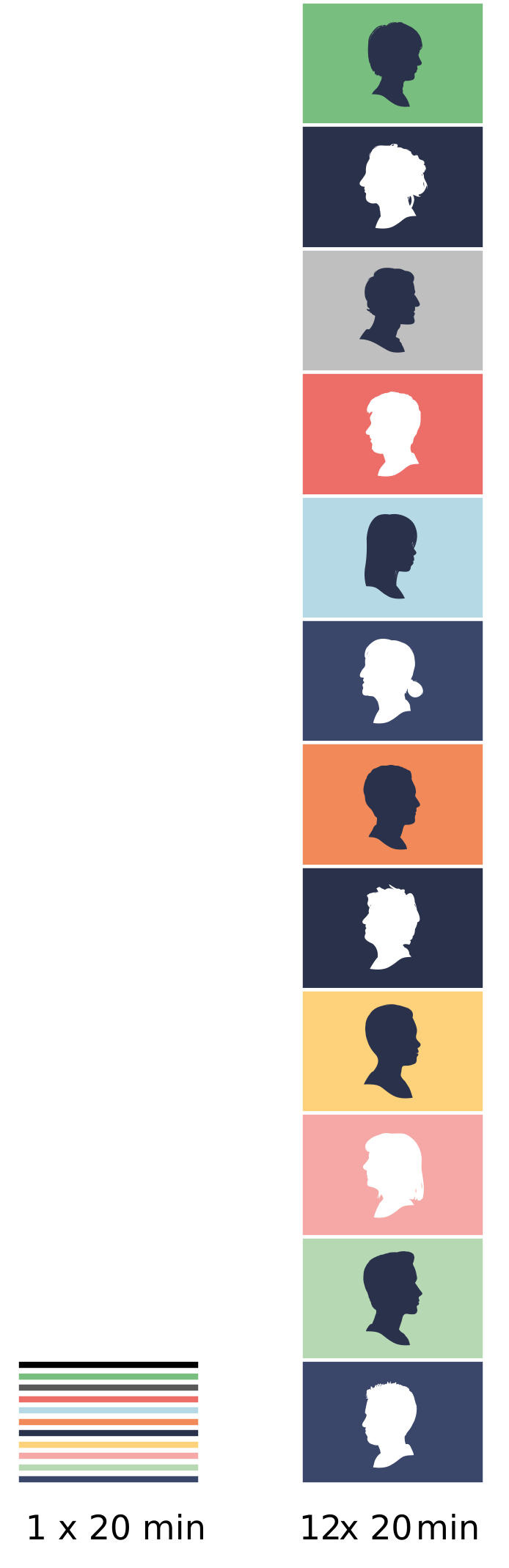
A 20-minute slot
can go further

Diagram showing how XLeap Discussion lets multiple participants contribute in parallel during a 20-minute HSE workshop segment, creating more time to examine causes, constraints, and controls.

XLeap Discussion multiplies the time available to work through causes and controls.

With XLeap, HSE leaders can keep the discussion anonymous. Participants can challenge assumptions, name constraints, question whether a proposed action will work, and describe why an existing control fails in practice without turning the discussion into blame, politics, or self-protection.

Deeper insight into a wider range of priority topics informs what follows—both in the workshop and afterward.
LEARN MORE ABOUT DISCUSSION

Working through causes in the XLeap Discussion workspace.

 

Four workshop failures XLeap helps HSE leaders fix

Critical input is not disclosed or dismissed

Critical input is not disclosed or dismissed

Anonymity lets participants disclose hazards, deviations, weak controls, near misses, unsafe conditions, and environmental concerns—so the group can assess them on substance, not source.
Relevant perspectives do not get a word in

Relevant perspectives do not get a word in

Simultaneous contribution lets all participants add input without waiting their turn. That matters because HSE workshop results depend on frontline, contractor, operational, and HSE perspectives.

Prioritization is too blunt

Prioritization is too blunt

Use the XLeap Rating workspace to triage fast: identify what deserves discussion, compare group views, and focus time where deeper insight will strengthen corrective actions.

Priority issues run out of time

Priority issues run out of time

The XLeap Discussion workspace lets the group examine multiple priority issues or corrective actions in parallel and in depth within the time available—candidly, from relevant perspectives, on substance.

Across HSE work

XLeap gives HSE leaders advanced workshop mechanics for HSE work that relies on workshops—from hazard identification and control reviews to incident learning, corrective-action planning, and environmental improvement work:

  • Hazard identification workshops
  • Job safety analysis / job hazard analysis
  • Control effectiveness reviews
  • Procedure and SOP reviews
  • Permit-to-work reviews
  • Incident and near-miss reviews
  • Root cause analysis
  • Corrective-action planning
  • Contractor safety workshops
  • Environmental deviation reviews
  • Emergency tabletop exercises
  • Audit finding closure workshops

Across these workshops—and whether in-room, virtually across locations, or hybrid—XLeap’s contribution stays the same: fuller disclosure, contribution from relevant perspectives, fast and nuanced prioritization, and deeper discussion where causes and controls need real work.


HSE workshops matter. Make them more effective

Use XLeap to strengthen the workshops your HSE work relies on: fuller disclosure of operating reality, clearer prioritization of issues that deserve deeper work, and in-depth discussion that shapes workable corrective actions and more effective controls.

Fuller disclosure · Clearer priorities · Stronger controls

Request a demo