But conventional workshop mechanics let them down. The larger the group, the less productive the workshop. People with potentially relevant observations must therefore often be left out. And even with a limited group, those present often struggle to get a word in.
Worse, uncomfortable risk signals are withheld or sugar-coated, while disclosed input can be discounted because of who raised it. Finally, conventional workshop tools are rarely up to assessing risks adequately against the organization’s criteria—at their simplest, likelihood and impact—and using the assessment results to determine priorities in line with its risk appetite and treatment strategy.
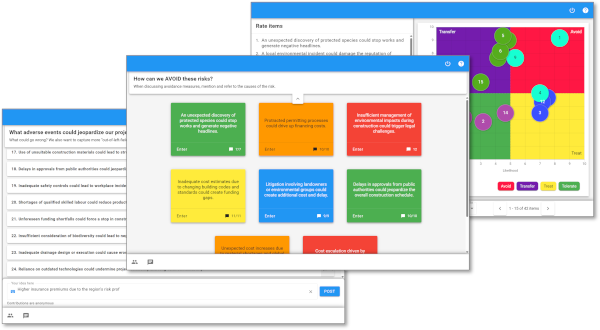
Workspaces for risk disclosure, assessment, mitigation planning
With XLeap workshop software, risk managers can bring in everyone they need, let participants contribute whenever they have something to add, grant anonymity where candor is essential, and apply their risk methodology.
Whatever the setting—in-room, virtually across locations, or hybrid—participants can disclose risk signals honestly, assess risks against the organization’s criteria, and see immediately what requires attention.
Surface more · Assess better · Treat what matters
- A field technician may notice early signs of degradation.
- A site team may rely on a workaround.
- A contractor may see an unclear handover.
- A supplier may know where response assumptions are unrealistic.
- A manager may suspect that a control is weaker in practice than on paper.
But only part of what is observed becomes active in the workshop.
Only part of what becomes active is fully disclosed.
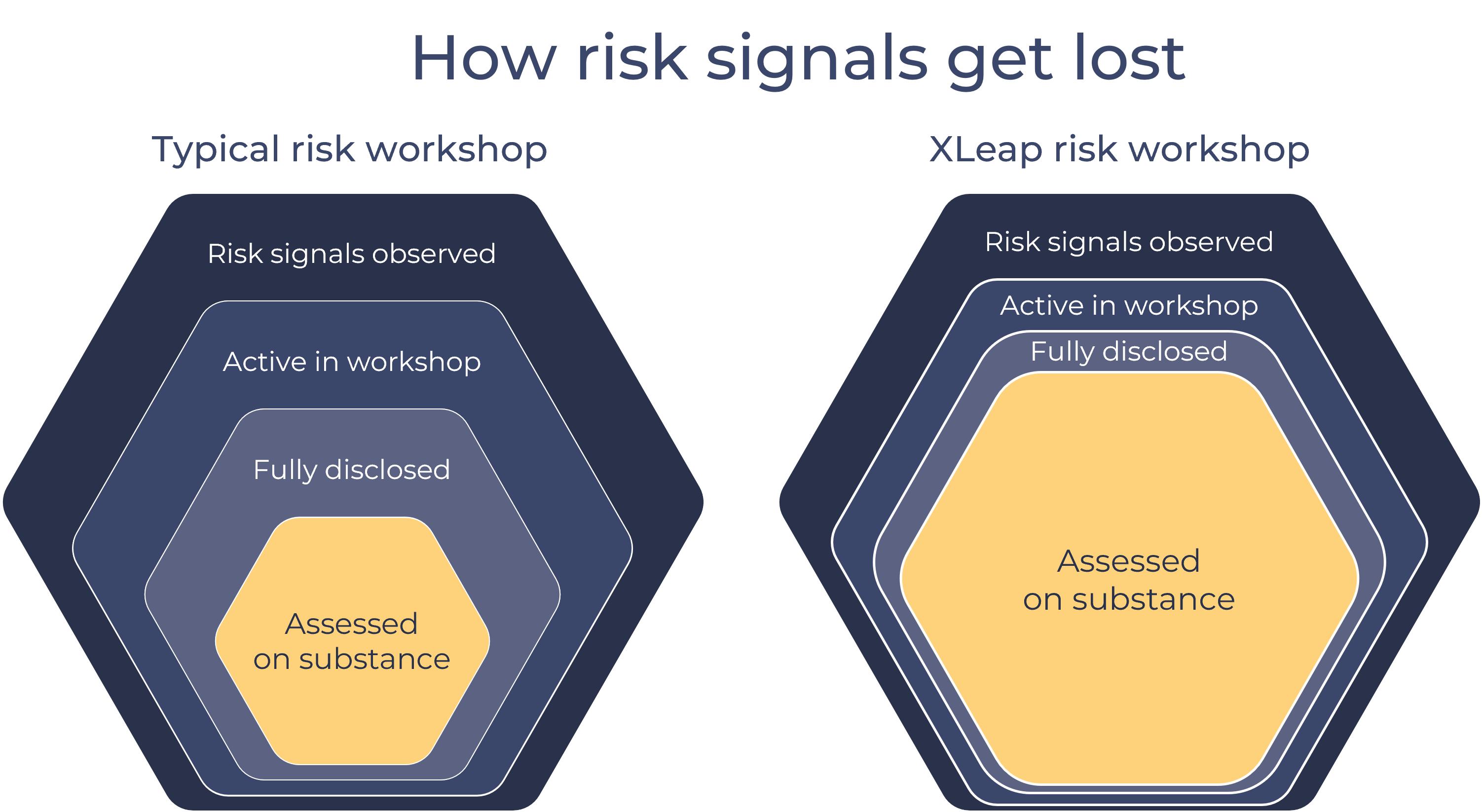
More risk signals assessed on substance.
And only part of what is disclosed is assessed on substance, rather than discounted because of who disclosed it.
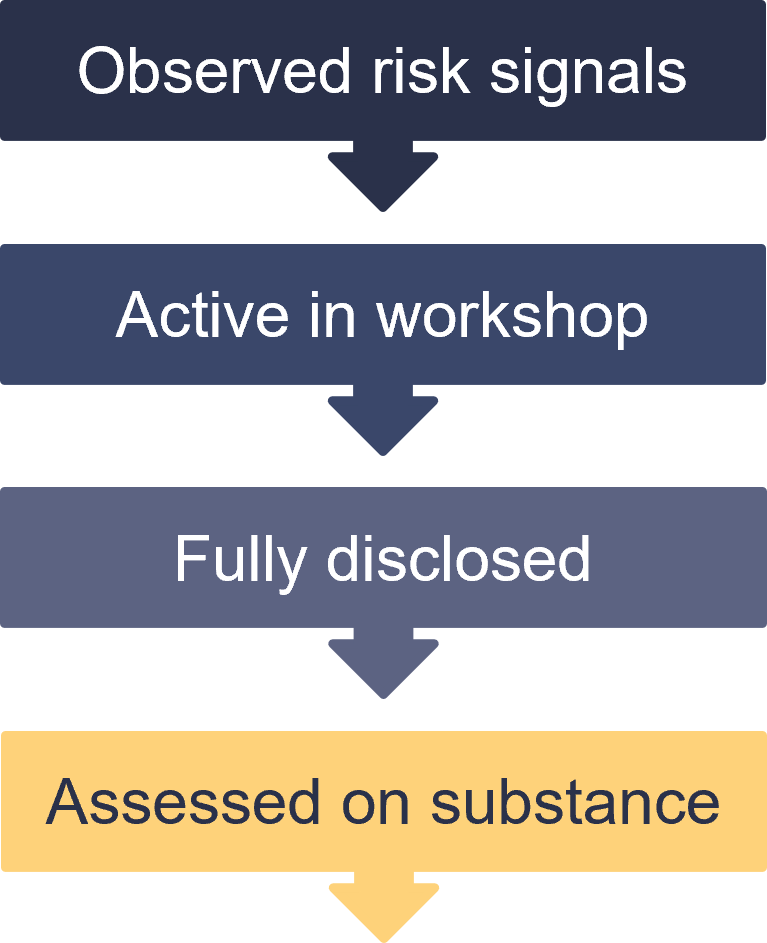
XLeap helps more of the relevant risk signals make it through with less distortion. Risk managers can bring in the relevant people close to the operation—including field teams, contractors, suppliers, service providers, and external experts—productively, instead of letting group-size limits narrow the scope of observations.
Dynamic brainstorming brings more of those observations to mind.
Host-controlled anonymity enables full disclosure.
Anonymous structured assessment helps the group assess what was disclosed on substance—not on who disclosed it.
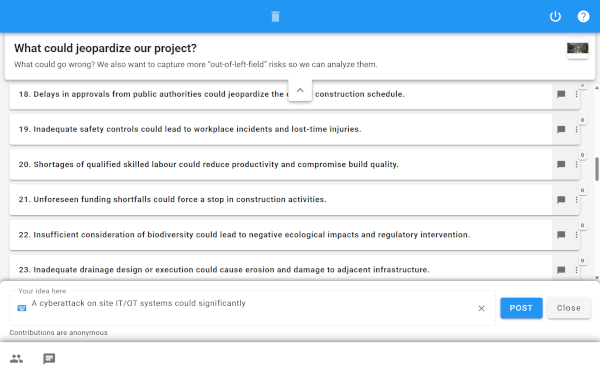
Anonymous brainstorming helps participants fully disclose risk signals.
That changes what the risk workshop can produce. Participants can disclose uncomfortable risk signals without exposing themselves to hierarchy, politics, blame, or source bias. The Host decides when attribution is useful—and when anonymity creates a more complete and less distorted risk signal.
Anonymity does not remove discipline from the risk process. It improves the input to it. Once a risk signal is disclosed, it can be clarified, assessed, rated, compared, escalated, or rejected on substance—and, where warranted, used to inform a risk treatment decision.
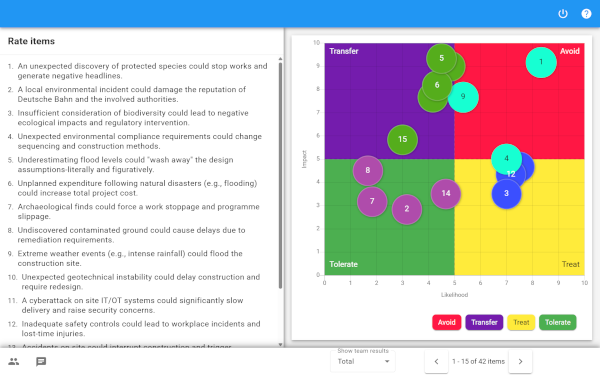
Risk matrices and heatmaps configured for your methodology.
The result is not just a list of discussed risks. It is a structured basis for risk priorities, mitigation, monitoring, escalation, acceptance, or other treatment decisions.

Group-size limits narrow the risk signal
Bring in the relevant people close to the operation—including field teams, contractors, suppliers, service providers, and external experts—and use dynamic brainstorming to activate more of what they know.

Uncomfortable risks stay undisclosed
Grant anonymity so participants can fully disclose risk signals that would otherwise be withheld, softened, euphemized, or stripped of consequences.

Source bias distorts assessment
Use anonymous structured assessment so disclosed risk signals are assessed on substance, not on who disclosed them.

Risk methodology is hard to apply live
Let participants assess risks against your criteria, compute indicator values in real time, and visualize results in customizable risk matrices, risk heatmaps, and priority views.
- Risk identification
- Risk and control self-assessment
- Risk assessment and prioritization
- Control effectiveness reviews
- Incident and near-miss reviews
- Root cause analysis
- Scenario analysis
- Operational resilience
- Cross-site risk reviews
- Contractor and supplier risk
- Mitigation planning
- Risk treatment reviews
Across these workshops—and whether in-room, virtually across locations, or hybrid—XLeap’s contribution stays the same: fuller disclosure, structured assessment, immediate results, clearer priorities, and better-informed treatment decisions.