But conventional workshop mechanics let them down. The larger the group, the less productive the workshop. Relevant stakeholders must therefore often be left out. And even with a limited group, those present often struggle to get a word in. They also hold back or sugarcoat concerns and objections. Finally, weak prioritization methods obscure what should take priority. Priority issues get shortchanged.
With XLeap workshop software, change managers can involve everyone relevant, grant anonymity where candor is essential, and let participants contribute whenever they have something to add.
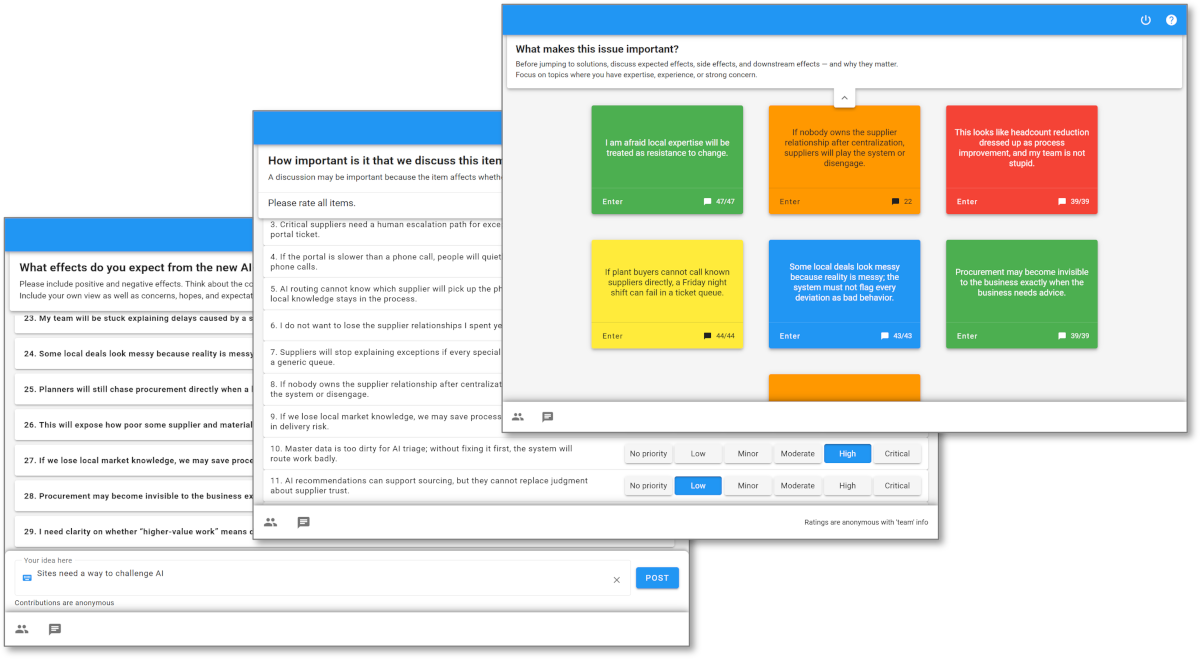
XLeap workspaces let change managers move from honest input to priorities and deeper discussion.
Whatever the setting—in-room, virtually across locations, or hybrid—participants can say what they really think, prioritize quickly and precisely, and then work through priority topics in the depth they require. That provides reliable change intelligence and clear priorities. Shared responsibility for making the change succeed strengthens implementation and helps embed the change in day-to-day work.
Honest input · Meaningful involvement · Constructive action
Those facilitating the workshop can do little to alter this subjective perception through invitations and assurances alone. They can speak for their own intentions, but not for how other participants may receive, remember, or later judge a critical contribution. Especially in tense situations, people are acutely aware that perceived disloyalty may be held against them.
Anything controversial said in the workshop may well be brought up later, in a different setting: “By the way, she shared some interesting views about your role.” The almost inevitable response is: “Tell me more.” No one facilitating a workshop—whatever their integrity and skill—can control how such remarks travel or what consequences follow. And participants know that.
“Let’s all be open and honest.”
An explicit invitation to speak openly can even reinforce a diffuse sense of unease: if safety has to be promised, there must be something to protect oneself from. In the back of people’s minds: where there is smoke, there is fire. This is a structural constraint that conventional facilitation cannot remove.
This constraint matters at two levels. When participants withhold or sugarcoat what they know, the workshop does not produce reliable change intelligence. When participation feels like a formality, it does not create motivation to make the change work. It can even reinforce cynicism and passive resistance and encourage informal workarounds.
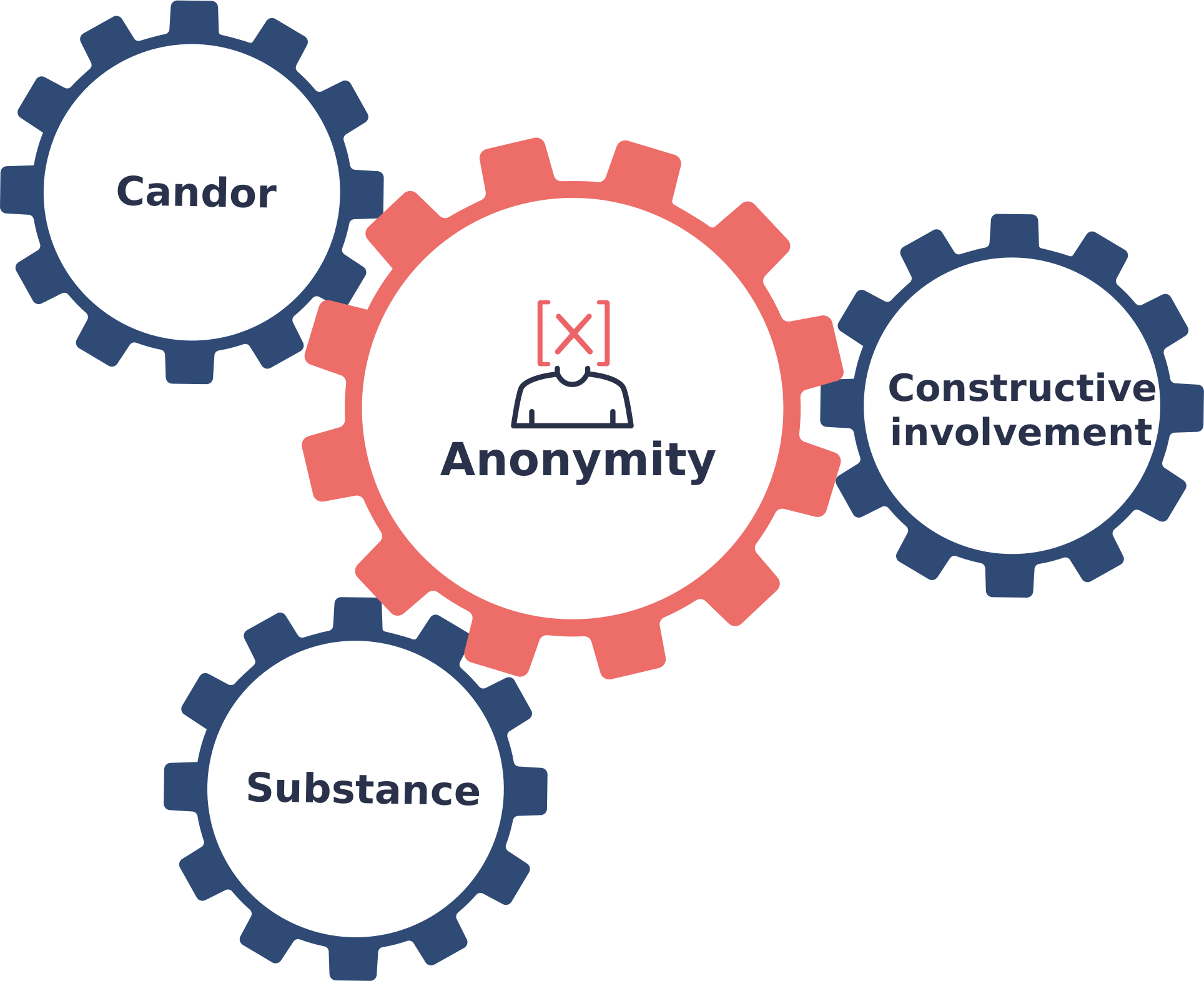
Anonymity protects participants from personal exposure—and keeps judgment focused on substance.
Anonymity resolves this constraint structurally. Participants do not have to trust that speaking openly will have no personal consequences: where anonymity is enabled, they can contribute without exposing themselves personally.
XLeap lets change managers grant anonymity where candor matters—giving participants not merely an invitation to contribute, but a practical opportunity to speak out. This is not limited to the first input step. Across XLeap workspaces, the Host can decide when attribution is useful—and when anonymity creates better conditions for candor, substance-based judgment, and progress.
That matters especially when a change feels threatening. Participants rarely make a conscious decision to hold back; they usually protect themselves instinctively: keep a low profile and wait to see what happens. Protected by anonymity, they can raise concerns and objections and submit ratings honestly—without taking a personal risk.
In a Brainstorm workspace, the Host can grant anonymity so participants can answer open-ended questions honestly in their own words: what concerns or interests they have, where they see adoption barriers, how the change affects their work, where their support or influence matters, and what would make the change work in practice.
Giving participants the freedom to raise issues themselves and describe them in their own words is one of the main advantages of a change workshop over prestructured surveys, which affected stakeholders often experience as a box-ticking exercise.
In an XLeap Discussion, participants can respond directly to comments others have made—instead of having to wait for permission to speak. Where anonymity is enabled, they can express themselves freely without turning every objection, doubt, or correction into a personal position.
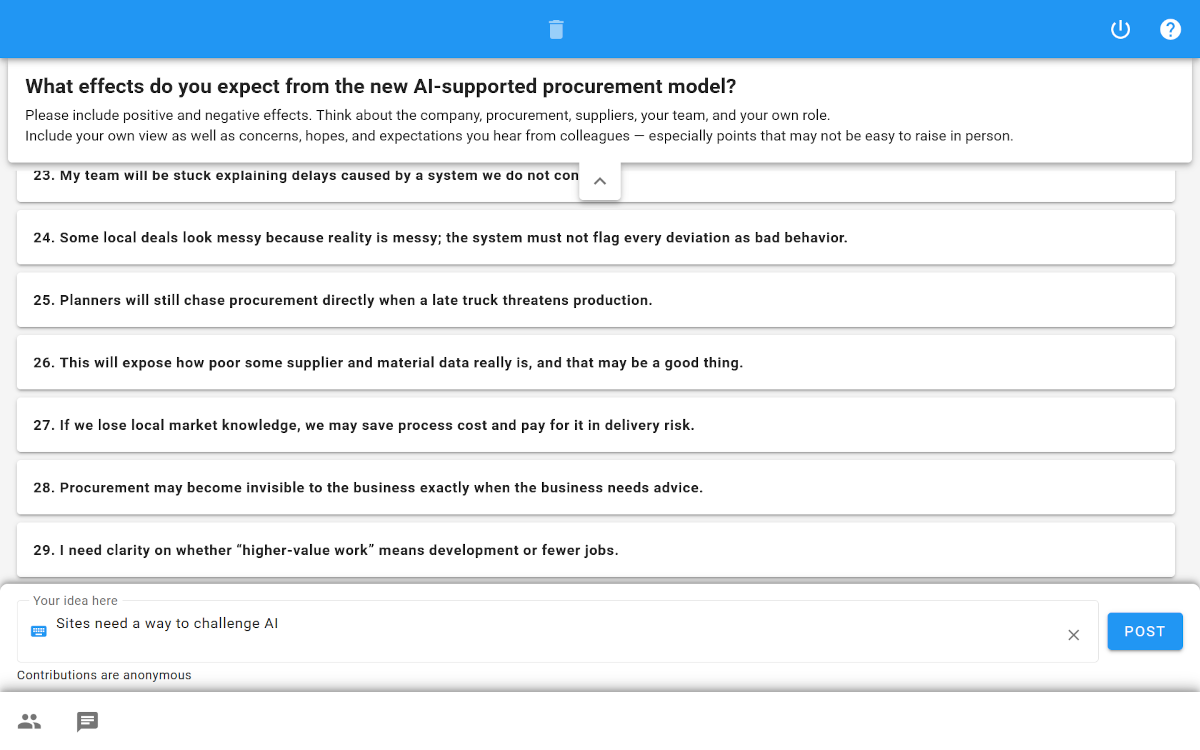
Brainstorming with anonymity captures concerns and implementation needs.
The result is more than feedback. Concerns, constraints, objections, local knowledge, implementation risks, and solution ideas come to the table without being softened. The group structures, rates, and discusses these contributions and derives concrete implementation actions from them.
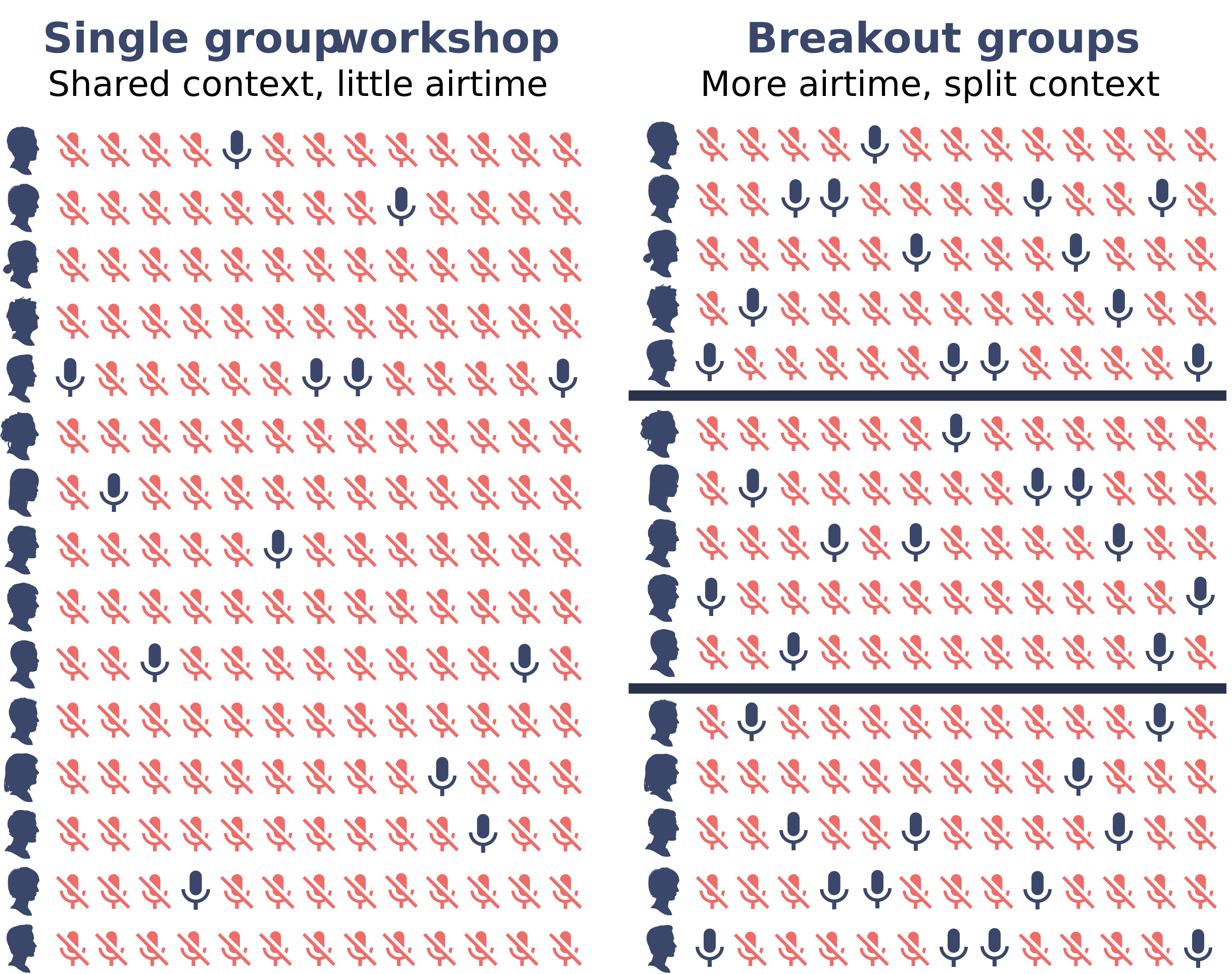
The traditional workaround: trade shared context for airtime.
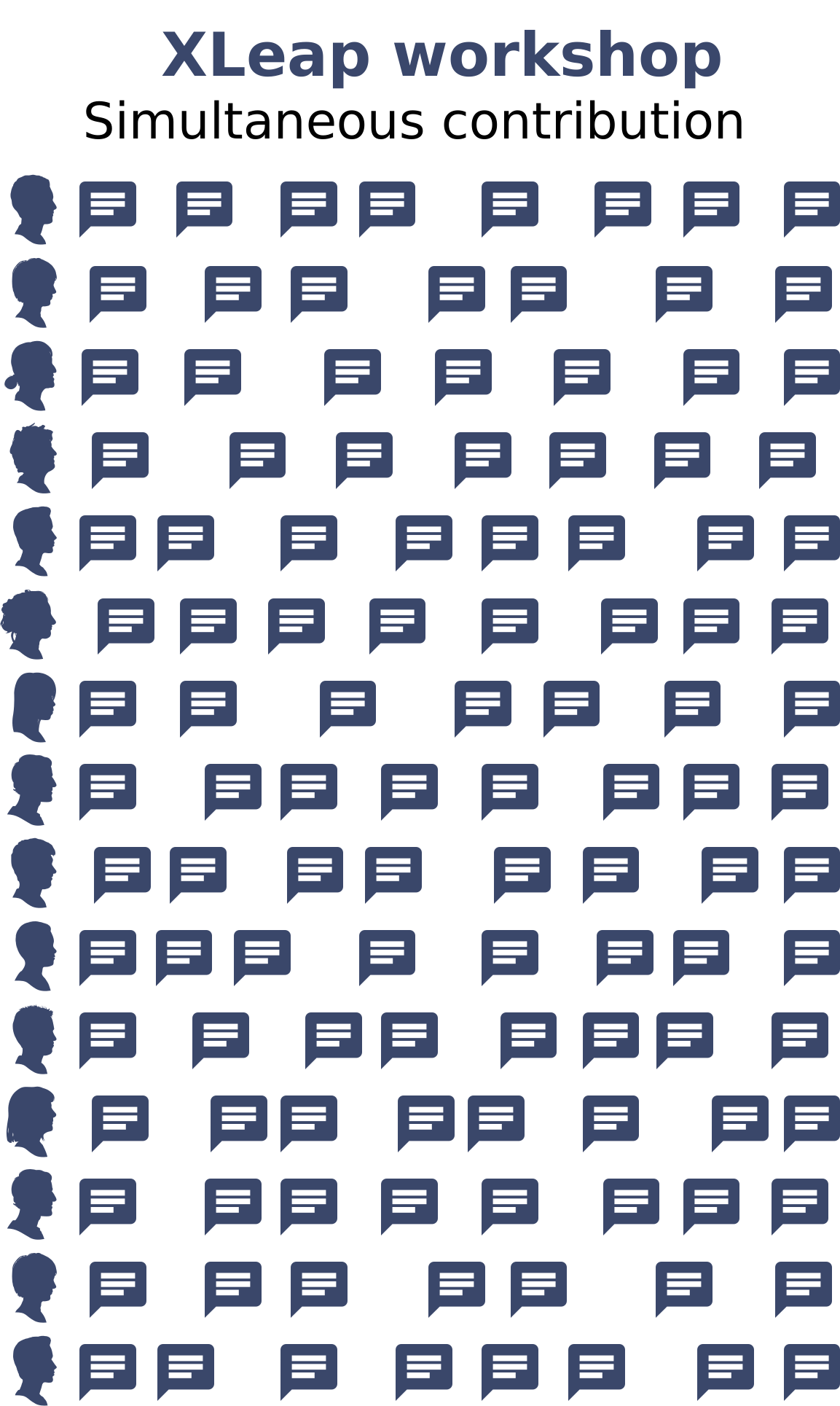
More contribution, shared context.
Neither side of that trade-off supports real engagement. Stakeholders who are not invited know their perspective was excluded. Stakeholders who are invited but cannot contribute feel processed rather than involved. Both experiences reinforce frustration, cynicism, and passive resistance—exactly what change managers are trying to move beyond.
The familiar workarounds only solve part of the problem. Breakout groups create more airtime, but they split the context: participants are involved only in their own breakout, not in the wider conversation. Written card exercises allow simultaneous input, but often at the price of communication: participants produce isolated contributions rather than responding to, challenging, and building on one another’s thinking.
With XLeap, this old dilemma no longer applies. Participants can contribute simultaneously in writing, see others’ contributions immediately, and respond to them directly. They can contribute and build on the evolving workshop content without waiting for permission to speak.
The result is not just broader participation. It is a better foundation for constructive engagement: more perspectives enter the conversation, more issues become workable, and more participants can help solve the problems that would otherwise block the change.
Workshop time is scarce

The most important issues first.
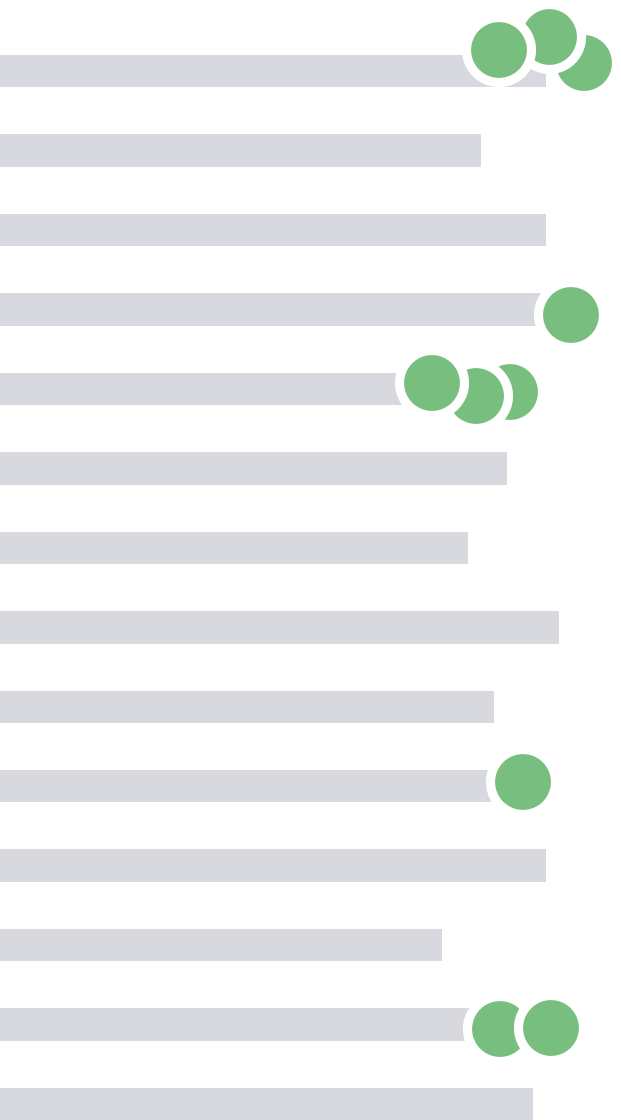
Sticky dots: limited insight.
With conventional workshop mechanics, prioritization usually relies on sticky dots or likes because they are the only feasible methods.
Sticky dots show only how often an option was selected. They do not show how participants judge it. An unselected item may still be considered very important or effective but simply not make the cut because each participant can make only a limited number of selections—or it may be regarded as irrelevant, ineffective, or even counterproductive. This makes all the difference. But who knows?
Suppose an impressive 40% of participants select an option. Does that make it the group’s favorite—or do the other 60% reject it? Sticky-dot voting cannot tell us. Consensus and dissent remain invisible.
Sticky-dot voting is also vulnerable to duplicates and easily distorted when participants follow the dots already placed instead of judging independently. Duplicate or overlapping options have to be consolidated before the vote, or they split support for what is essentially the same issue. Preparing, running, counting, and reporting the vote adds further effort. The insight is limited; the time required is substantial.
For more complex rating tasks, such as assessing options against several criteria, sticky dots reach their practical limits. Different colors may represent importance, urgency, feasibility, or other criteria, but compiling and analyzing the results takes more time than the limited insight justifies—and more than is realistically available in a workshop.
That makes prioritization too infrequent and too blunt. The group spends scarce workshop time on secondary issues while critical readiness gaps, adoption barriers, or transition risks remain underexplored. Participants notice when the workshop fails to address the issues that matter most to them. That weakens their sense that involvement is meaningful—and their motivation to help make the change work.
With XLeap, Rating becomes a fast, precise, transparent, and repeatable workshop step. Change managers can prioritize whenever the process requires it.
The Host defines what participants rate and how. XLeap supports a wide range of methods, from multiple selection to assessments against several criteria—for example, importance to implementation, urgency, expected impact, feasibility, or need for action.
XLeap presents the results immediately in tables and charts. Change managers can order issues by priority, examine results across multiple criteria, and see where judgments converge or diverge.
Analysis by participant group shows which functions, sites, or stakeholder groups see themselves as particularly affected—and how widely that view is shared within each group. A moderate overall result may conceal an issue that is critical to those closest to the work or most directly affected by the change.
Differences may reveal distinct experiences or assumptions, previously unspoken objections, overlooked dependencies, or practical barriers to implementation. XLeap gives change managers the nuance they need to guide the group toward what deserves closer examination, requires clarification, or should receive greater attention and effort.
The transparency also matters to participants. They can see how priorities emerge from the group’s judgments and how their own assessments steer what the workshop addresses. They experience their involvement as consequential. That strengthens their motivation to engage with the priorities and help carry the resulting actions forward.
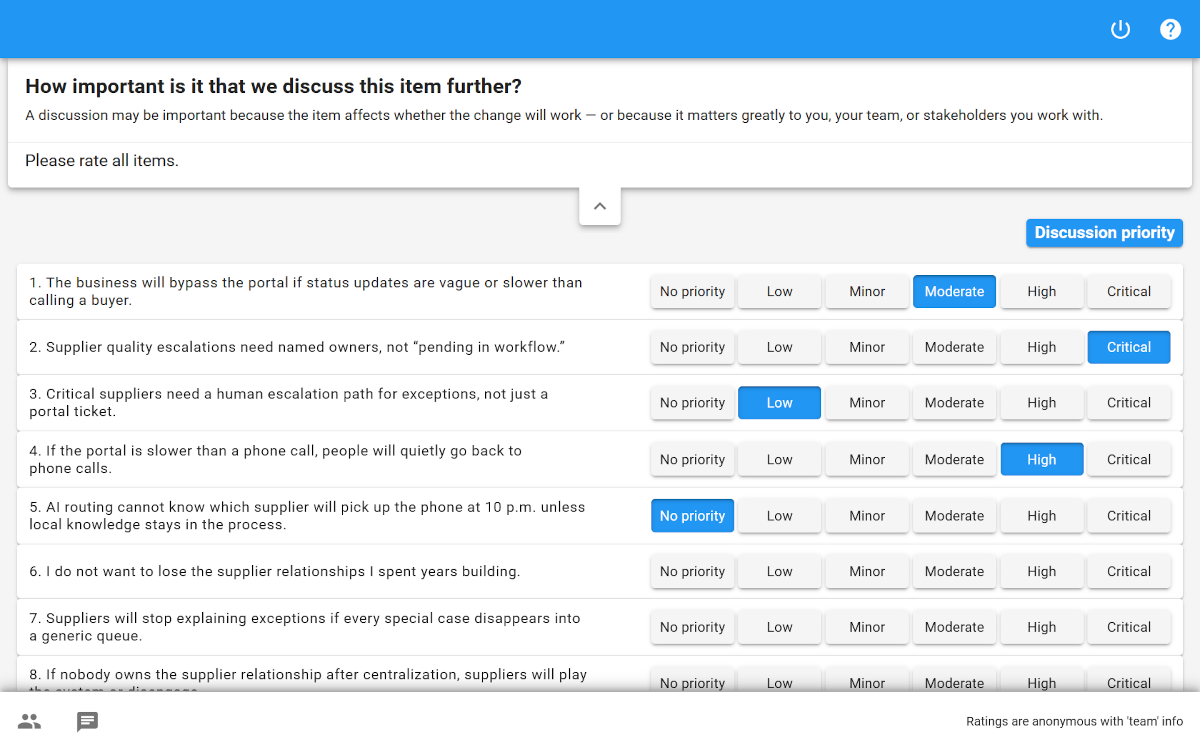
The group rates what takes priority.
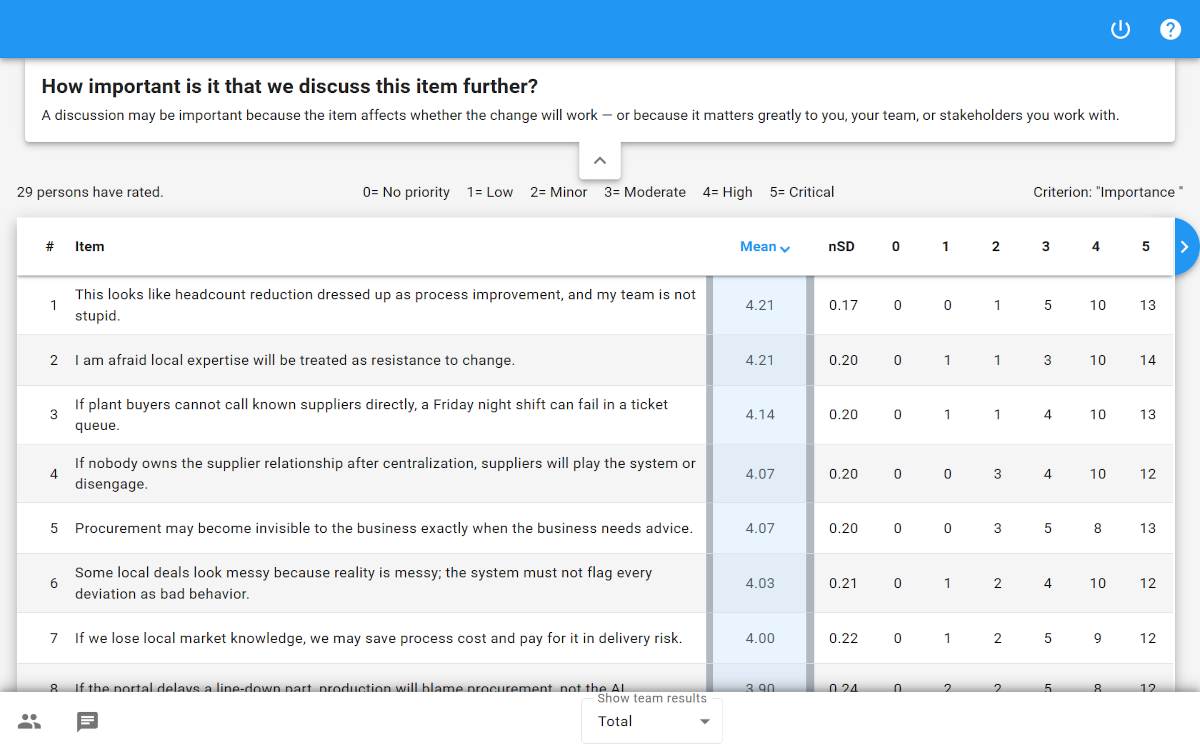
Results are available immediately.
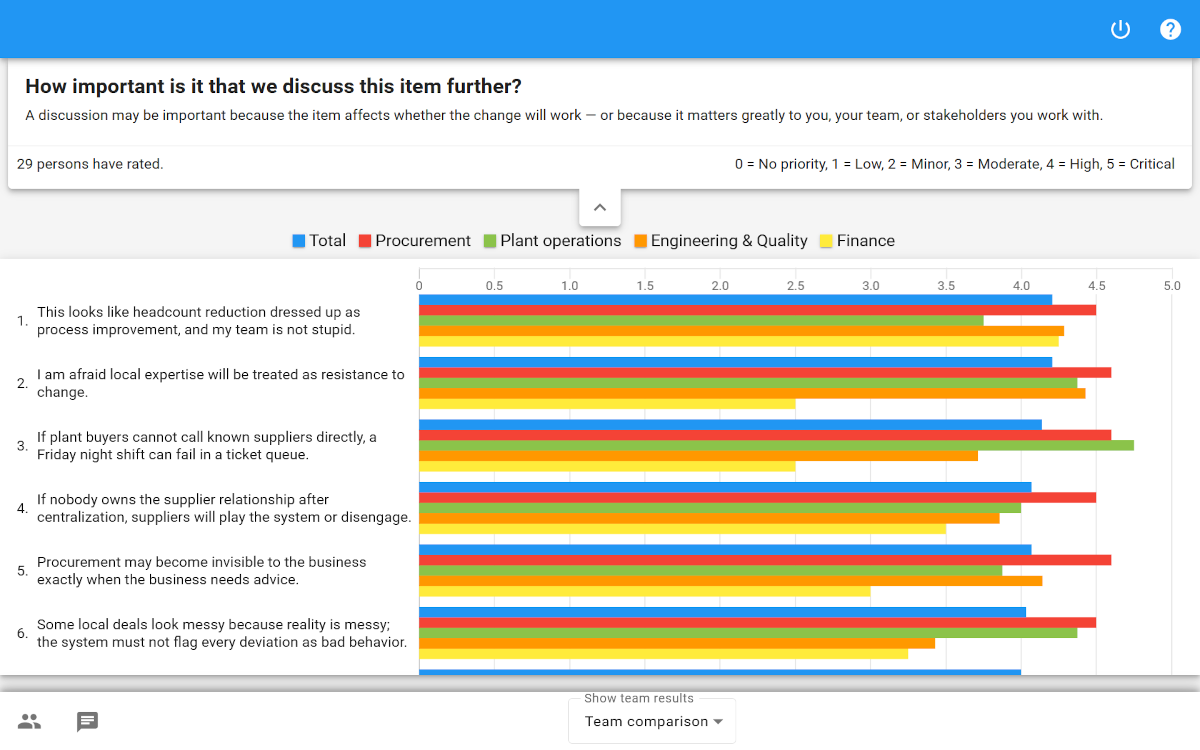
Participant-group comparison reveals different priorities and judgments.
A 20-minute slot
can go further
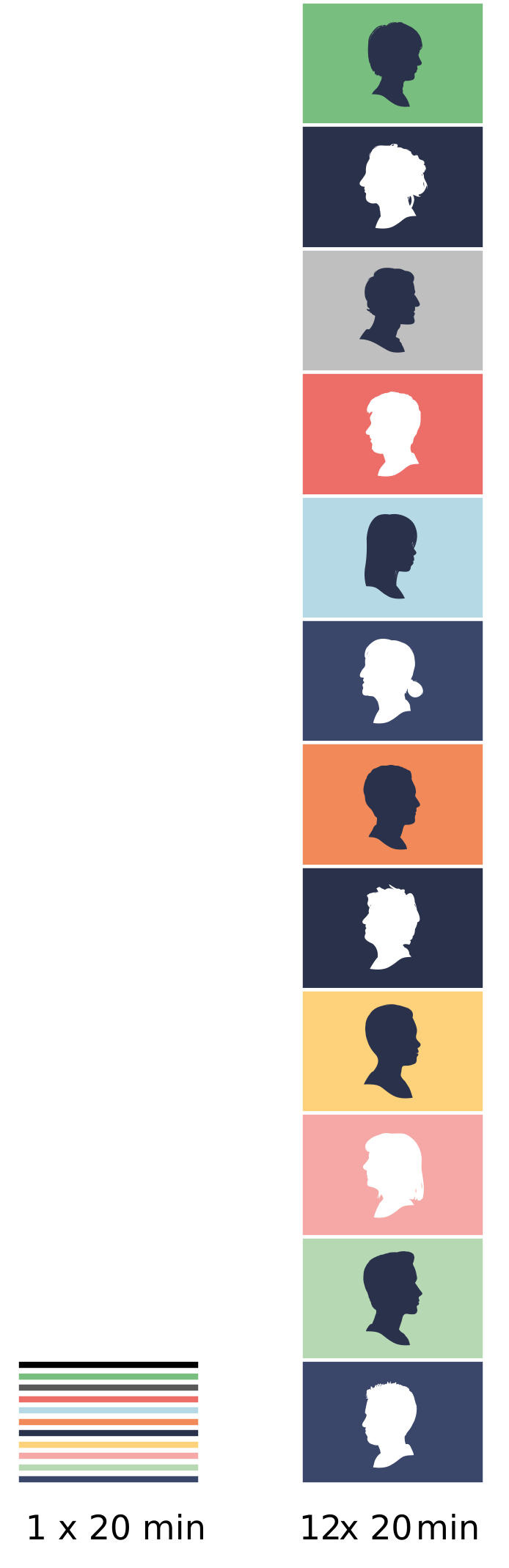
XLeap Discussion multiplies contribution time.
The result is deeper change intelligence. Participants can focus on the issues where their perspective, judgment, and contribution to the solution matter. That strengthens motivation. Change managers gain a better understanding of which issues matter to whom and why, where views differ, and what it takes for implementation to succeed.
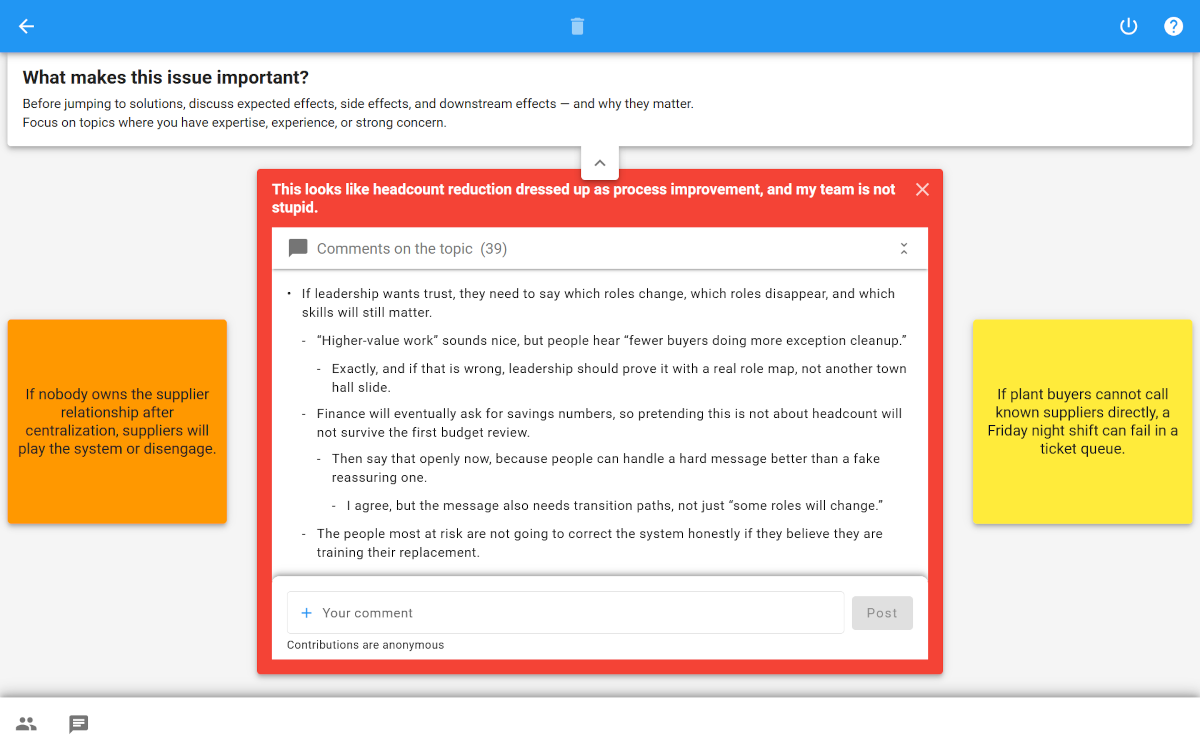
Stakeholders go deeper on the group’s priority topics in parallel.

No candor, no real involvement
When stakeholders cannot raise real concerns and objections, the workshop can feel like involvement for show. XLeap lets change managers grant anonymity where candor matters, so participants can say what they really think—and feel heard.

One speaker means everyone else waits
When only one person can speak at a time, all other stakeholders can only listen while the moment for their input passes. XLeap lets everyone contribute when they have something to say, while the change manager keeps the workshop moving.

Poor prioritization misses what matters
When the mechanics of prioritization are too crude or too slow to use often, workshop time gets spent on secondary issues instead of critical concerns. XLeap Rating produces instant, precise results, so the group can work on what deserves attention.

Even priority topics stay underexplored
Spoken discussion can only address one topic at a time; breakouts help with airtime and topic coverage, but split the context. XLeap Discussion multiplies contribution time, so stakeholders can go deep on multiple priority topics in parallel.
- Change impact assessment
- Resistance analysis
- Training needs assessment
- Operating model transition
- Change readiness assessment
- Adoption planning
- Transition risk assessment
- Process change
- Stakeholder analysis
- Communication planning
- Rollout planning
- Post-implementation reviews
Across these workshops—and whether in-room, virtually across locations, or hybrid—XLeap’s contribution stays the same: candor where it matters, contribution when stakeholders have something to say, prioritization when attention needs focus, and deeper discussion where priority topics need real work.