Advanced workshop mechanics
Rigorous prioritization

Workshops generate more issues, ideas, and options than can be worked through. Professionals therefore need to determine what matters most and where the work should consequently go next—often several times during a workshop.

Yet legacy workshop mechanics make this fundamental facilitation task difficult. Sticky-dot voting, likes, and similar methods are too cumbersome to use as often as necessary. They reduce group judgment to selection counts, can be manipulated, and routinely mislead. Without frequent, dependable prioritization, scarce workshop time gets spent on secondary issues while what matters most gets shortchanged.

When a material decision involves several criteria, constraints, or trade-offs—as most material decisions do—such methods are entirely inadequate.

XLeap workshop software now removes this structural limitation. It gives professionals a choice of rating methods that fit the task. Rating is fast, transparent, and precise, with results available immediately. Professionals can therefore prioritize whenever the work requires it and steer the work for greatest effect.

Beyond steering the work in the workshop, professionals can use XLeap’s multi-criteria Rating and analysis to create a structured, quantified basis for better-informed, more robust decisions.

Prioritize precisely · Steer the work · Inform decisions
Request a demo

Prioritize without delay—and again

A brainstorm may surface 50 issues. Without immediate prioritization, the next topic is often not consciously chosen. Someone picks up an interesting or emotionally charged issue, others respond, and the group follows. Interest in discussing an issue becomes a proxy for its importance. A rabbit hole appears—and the minutes are gone.

That is human. The math is brutal. If the group will ultimately identify five top priorities, an issue picked at random is nine times more likely to fall outside the top five than inside it. Odds are that every minute spent before priorities are known is a minute taken from higher-priority work.

With XLeap, simultaneous contribution can put much more input into play. That makes immediate prioritization more important, not less.

But priorities do more than determine what deserves discussion. Prioritization steers the work, whatever comes next. Which issues should we address? Which deserve deeper analysis? Which measures should we develop? Which actions warrant further work? Prioritization gives professionals a dependable basis for deciding where to direct the group’s time and effort—and what to leave aside, based on explicit criteria tied to the workshop’s purpose.

And the need keeps returning. Prioritize the issues. Brainstorm possible measures. Prioritize again. Identify obstacles and concerns. Prioritize again. Whenever the work produces another set of issues, ideas, or options, professionals can establish priorities quickly, transparently, and precisely—then steer the work efficiently.

Use the method that fits the task

Not every prioritization question asks for the same judgment. The rating method should fit the task—not limit the judgment the task requires.

Sticky-dot voting and likes do exactly that. A fixed number of selections cannot show whether an unselected item narrowly missed the cut, is irrelevant, or is even counterproductive under the chosen criterion. Different formulations of the same issue can split support. Selection counts can therefore create a false picture of priority.

If the group needs to assess importance or effectiveness, a numerical scale may fit. If everything comes back “very important,” Rank order forces a hierarchy. If the question is effort, Estimate lets participants give a meaningful quantity such as person-days instead of an arbitrary effort score. If money or capacity is constrained, Budget allocation builds that constraint into the prioritization.

XLeap gives professionals these options so they can ask the question the task actually requires. The result is not merely a shortlist. It is a precise expression of the group’s judgment, tied to the workshop’s purpose.

Fast. Honest. Unhurried.

XLeap Rating is fast because participants go through their electronic Rating sheets in parallel—not because they have to decide quickly. Each participant can consider the options and criteria at their own pace and form their judgment independently while everyone else does the same.

Where ratings are anonymous, participants can judge honestly without exposing themselves personally. They do not have to manage hierarchy, relationships, reciprocity, or repercussions while forming their judgment. Attention stays on the substance.

Where the items themselves were contributed anonymously, their source cannot influence the assessment either. Participants judge the contribution on its substance rather than the status, reputation, or affiliation of its author.

This is fundamentally different from sticky-dot voting, where participants make visible choices at the board with earlier choices already on display, while others wait, watch, or move in behind them.

XLeap saves group time without taking reflection time away from participants—or burdening that reflection with personal exposure.

More than a ranked list

XLeap Rating does not just show what rises to the top. It provides much richer data that the group can analyze together to understand what lies behind the result and decide what should happen next. Participants can see how the group’s judgments translate into priorities and how those priorities steer the work.

If brainstormed items have been categorized, they retain those categories in the Rating sheet. Suppose the top five measures all come from categories B and E, while nothing in A, C, or F is even relevant under the chosen criterion. The group can immediately see which categories matter for the task at hand—and which do not.

Results can also be analyzed by participant group without exposing individual ratings. An average is not the whole result. The same average can reflect broad agreement or sharply divided judgments. XLeap shows the distribution behind it, revealing where judgments align and where significant dissent remains.

XLeap’s advanced workshop mechanisms reinforce one another

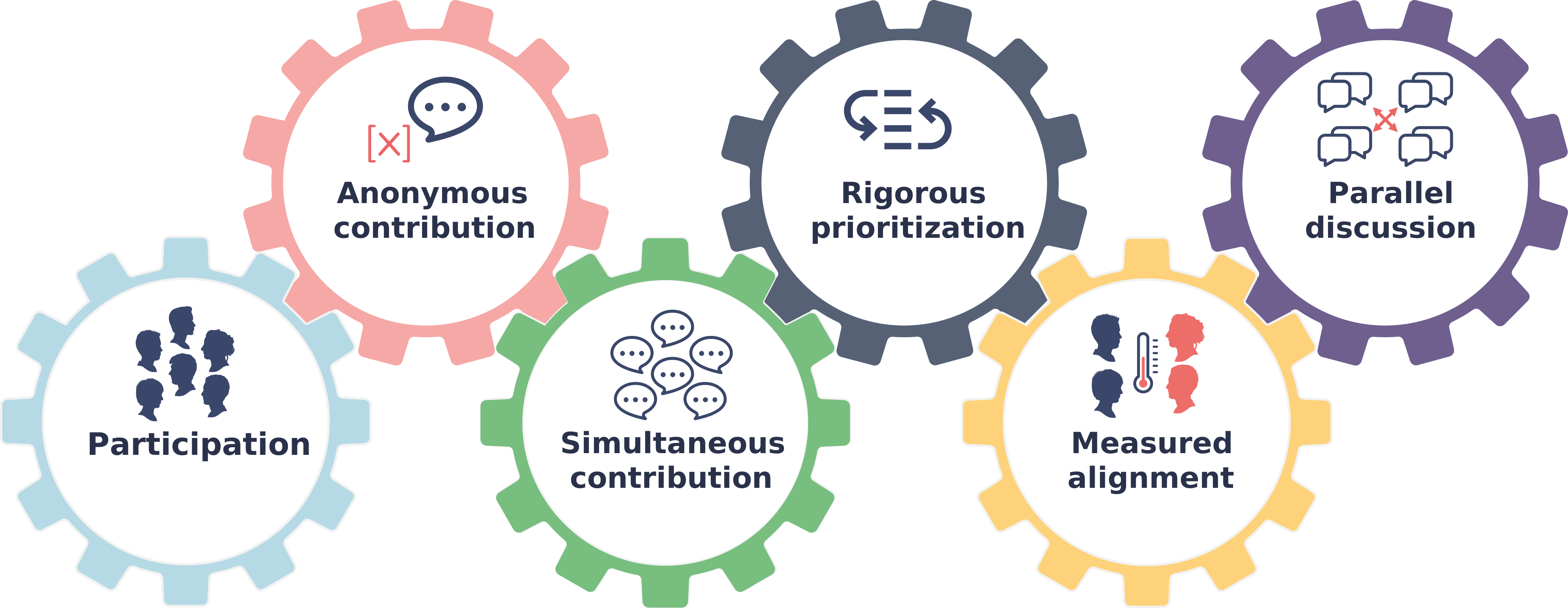
Participation brings the right people into the assessment. Anonymous contribution supports frank judgment. Simultaneous contribution makes Rating fast without rushing reflection. Rigorous prioritization focuses the work. Measured alignment shows whether priorities reflect shared judgment or significant dissent, including differences between participant groups. Parallel discussion lets the group go deeper on more priority or contested issues than legacy mechanics allow.

Six interlocking cogwheels representing XLeap’s workshop mechanisms.

Better judgment comes from mechanics that work together.

EXPLORE THE OTHER MECHANISMS

Participation · Anonymous contribution · Simultaneous contribution · Measured alignment · Parallel discussion

Take the assessment as far as the task requires

Sometimes a shortlist is enough. Sometimes professionals need richer data to steer the work. Sometimes the group needs to compare alternatives and make a decision in the workshop. Sometimes the purpose is to capture structured judgment for analysis and decisions afterwards.

Multi-criteria assessment lets the group rate the relevant items against several dimensions. In some disciplines, it is itself the prioritization method from the outset. Risk assessment, for example, routinely assesses risks across factors such as likelihood and impact.

Where the dimensions do not carry equal importance, professionals can weight the criteria accordingly. For comparing alternatives, utility analysis can combine judgments across desired outcomes, costs, risks, and other relevant criteria.

Qualitative work may have produced rich arguments, qualifications, and trade-offs. Multi-criteria analysis structures and quantifies the resulting judgments against the dimensions that matter, making complex judgment easier to interpret without discarding the reasoning behind it.

Results tables can calculate indicators in computed columns, apply thresholds, and support sensitivity analysis. The group can examine the result together as soon as the Rating closes.

Results charts can map assessed items against freely configurable backgrounds. Professionals can define the axes, regions, thresholds, and background logic that fit the task. They are not limited to a standard four-quadrant matrix. A risk team might plot assessed risks on a heat map reflecting the organization’s risk appetite, tolerance, escalation, or treatment criteria. A change or OD professional might map stakeholders by influence and interest on a matrix with zones tailored to the engagement approach.

The visual model follows the task—not the other way around.

Where real-time analysis adds value, professionals can work through the results with the group while the relevant people are still available. Where the underlying qualitative reasoning has been captured in XLeap, decision-makers can drill back into the arguments when a result needs explanation. All tables and charts used during the workshop are, of course, documented in the session report.

Where the data is intended to inform a later decision outside the workshop, it can be exported in Excel format for further analysis and visualization with the specialist tools used in the relevant discipline.

Abstract graphic showing many participant collaborating successfully
Abstract graphic showing two smaller groups collaborating independently

Prioritize for better decisions

With XLeap, prioritization is no longer a cumbersome exercise to ration. Professionals can establish priorities as soon as they are needed, repeat the process as the work develops, and use the method and depth of analysis the task requires.

From a fast shortlist to multi-criteria decision support, the purpose stays the same: direct scarce time, attention, and resources where they matter most.

Prioritize precisely · Steer the work · Inform decisions

Request a demo

EXPLORE FURTHER

Use cases · Workspaces